
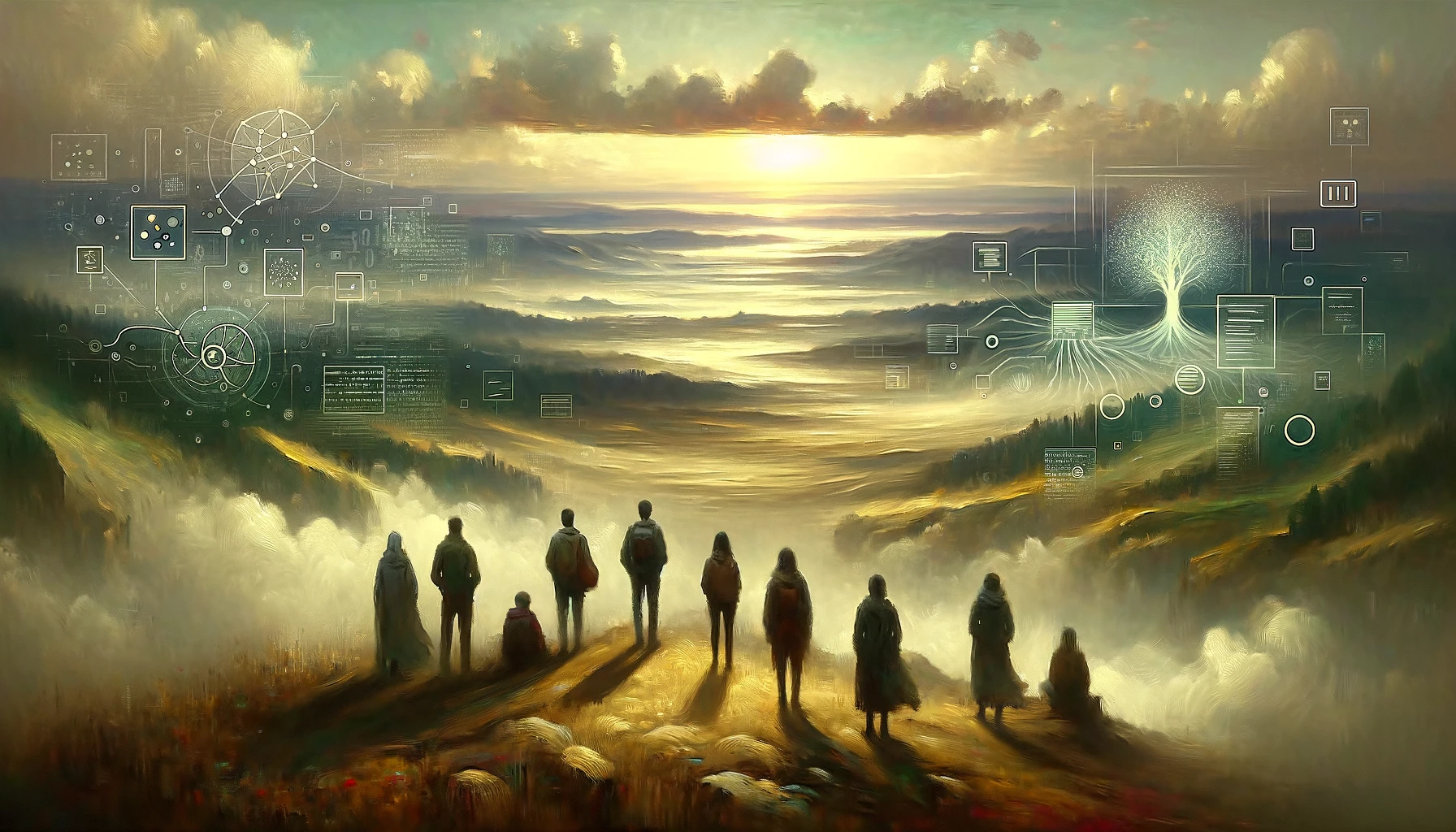
[Image generated with DALL-E 3]
My life has come close to AI in different moments. I wrote my first AI program in 1999 (in Prolog), my first neural network in 2001. But I have mostly remained as an AI sceptic, more devoted to explore how Artificial Life models can partially disclose some of the intricate mysteries of life (biological, psychological, and social) than to the possibility of computer programs achieving anything close to human-level linguistic competence. I started to feel that something was changing in AI research when DeepMind first claimed to have succeeded in playing Go and, more importantly, in playing different computer games, using human controls (e.g. first-person visuomotor feedback), and without knowing or encoding the game rules in advance (Schrittwieser et al. 2020).
Philosophy has spent the last couple of centuries announcing the death of God, it is now time to remember that AI is not alive.
I could smell something was about to change quickly. Other indicators were already clearly visible (big tech buying small AI firms, among others). So, when I read that a company called OpenAI was accepting requests to use their GPT3 API, I rapidly signed for early access. I got hands onto GPT the 26th February 2021. I spent almost three days in a row hooked to my computer. I couldn’t believe what I was experiencing. Despite the lack of fine-tuning, the numerous hallucinations, the confusing interface (I had to discover what “prompting” meant for myself), … the experience was absolutely overwhelming. On my understanding of what computer could do, they simply were not supposed to do that 🙂
AI-driven corporation are already the new Gods, showing themselves as living on the clouds, as omniscient, omnipotent, transcendent, mysteriously incomprehensible, and biased, like any other God before
Parallel to my research on philosophy of mind and cognitive science, I have been a tech activist for a couple of decades. I could feel that what I just witnessed, talking to a computer program that wasn’t playing the silly psychoanalytic trick, was about to “change everything”. Two years latter I am still not surprised, although I start to be tired, of hearing it. And they are good reasons for it.
AI is really a compressed form of digitized and automatized Collective Intelligence
It is still difficult to stop thinking on the philosophical, political and, at large, social consequences of the changes to come (none of which, by the way, should make us forget that caring for human lives, and for life on earth must, be the absolute priority for everyone, that there is no AI that is going to save us).
During these couple of years I have been asked to participate in different talks, interviews, round-panels, etc. And 2023 was particularly active. Collected here, you can find a number of media interventions in English, Spanish and Basque, where I elaborate on different aspects of the ongoing AI «revolution». In these interventions, I have aimed to explore the ethical, societal, and technological dimensions of AI, reaching out to diverse audiences. But they all touch upon 3 main ideas:
- If not all, at least the most recently successful AI, is really a compressed form of digitized and automatized Collective Intelligence, that is the structured result of large scale human cognitive live sedimented in the huge mathematical apparatus sustaining AI, on the gigantic corpus of textual and visual data used during training and the huge amounts of cognitive and emotional labour put on reinforcement learning and curating the data.
- The transformations to come are so deep that, in order to understand and cope with it, we might only rely on socio-cultural resources coming from religious studies and the transformations that the invention of writing brought to human life. AI-driven corporation are already the new Gods, showing themselves as living on the clouds, as omniscient, omnipotent, transcendent, mysteriously incomprehensible, and biased, like any other God before. Philosophy has spent the last couple of centuries announcing the death of God, it is now time to remember that AI is not alive. And yet, for years to come, we might not be able to live without AI. In a sense, they are the new undead Gods.
- We are the life of AI, and the complexity and power of these new technologies cannot rest on the hands of private corporate industries. Democratizing AI is an urgent task. It already belongs to us, we need to reclaim it back. Beyond regulation, political action need to take innovative agency. It is not about acceleration or deceleration, it is about steering our futures.
1. Interventions in English

- TALK: «Artificial Collective Intelligence and Democracy through Decidim» I was invited to deliver a talk on AI and Democracy at the #DecidimFest23 on a session entitled «Artificial Intelligence for Citizen Participation», on November 14, 2023, focusing on the application of AI in enhancing citizen participation. Watch on YouTube
- MAGAZINE INTERVIEW: Artificial Collective Intelligence and the Future of Participation and Artificial Democratic Life: An interview conducted on November 17, 2023, exploring the role of AI in shaping democratic participation and collective intelligence.
2. Interventions in Spanish
- RADIO INTERVIEW: Ética para la Inteligencia Artificial: From the “Leaders in Tech” series on EITB (October 28, 2023), this segment delves into the social and political aspects of AI development. It is a relative long interview for a public radio station (about 45 minutes) and I enjoyed the experience. I didn’t choose the title and I don’t like it, but I came given to me. Link
- TALK: «¿Qué es eso que llamamos Inteligencia Artificial y a dónde nos lleva?» This is an invited talk, on October 26, 2023, within a panel at the Real Sociedad Bascongada de Amigos del País (something like the British Royal Society, created in 1764 in the Basque Country). My talk is of about 30 minutes from min 23 to 55 on this YouTube recording.
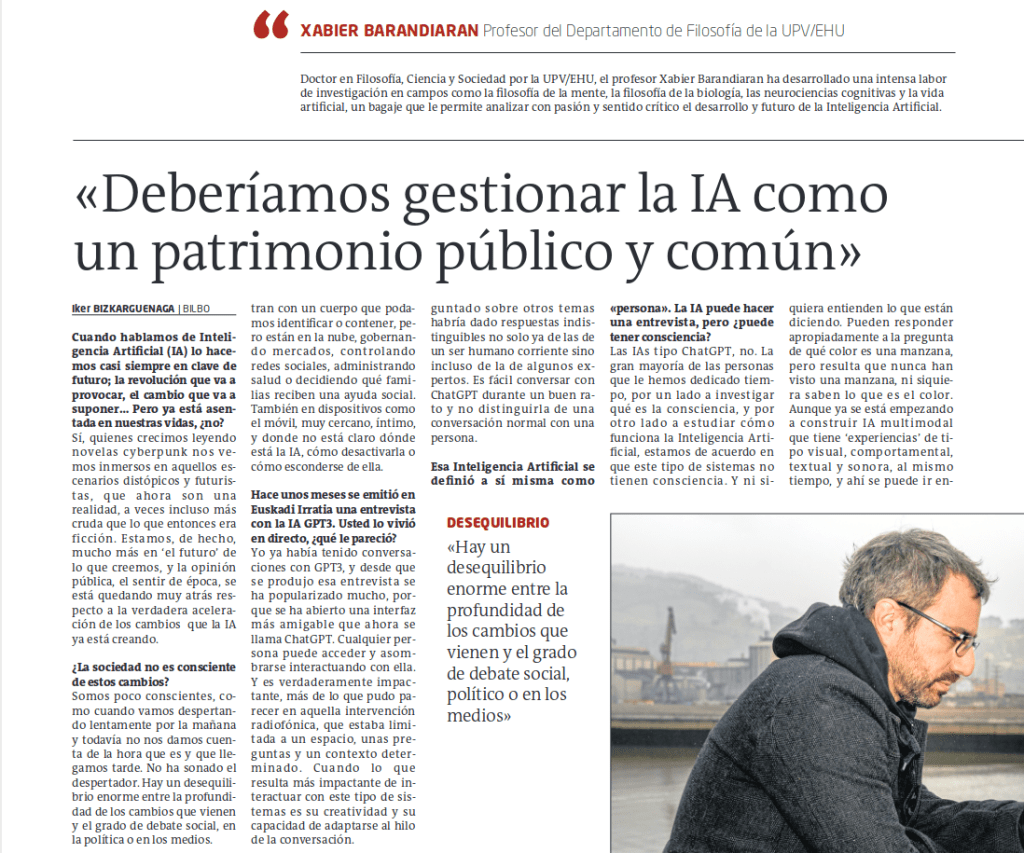
- NEWSPAPER INTERVIEW: «Deberíamos gestionar la Inteligencia Artificial como un patrimonio público y común«: An interview with I. Bizkarguenaga for Gara (January 16, 2023), advocating for AI as a public heritage.
3. Interventions in Basque
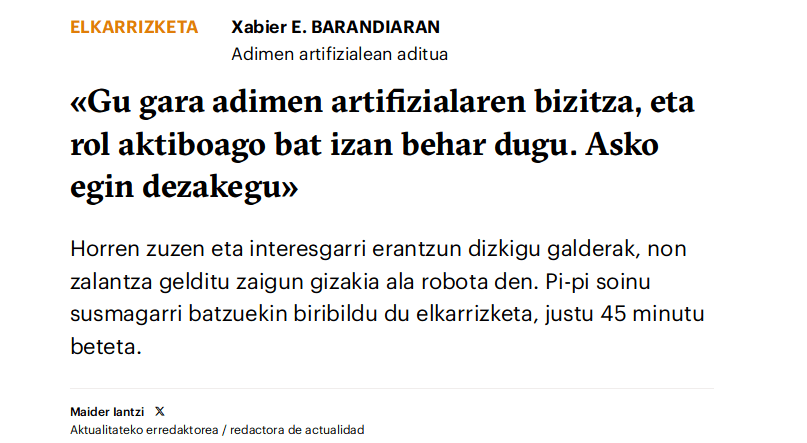
- MAGAZINNE INTERVIEW: «Gu gara adimen artifizialaren bizitza, eta rol aktiboago bat izan behar dugu. Asko egin dezakegu«: A long interview conducted by M. Iantzi for GAUR8 (November 16, 2023), a nice transcript and, so far, the most complete published interview.
- RADIO INTERVENTION: «GPT3 adimen artifiziala elkarrizketatu du ‘Faktoria’k«: An exploration of GPT-3’s capabilities on EITB’s «Faktoria» with Guridi, I., on November 4, 2022. In a previous interview, I convinced this radio program directors that they could interview an AI system. It took them almost a year to make this step, when they finally did (with the help of NLP experts from my university) I was invited to participate on the programme.
 Xabier E. Barandiaran