Generative Midtentionality: How AI could change intentionality

Barandiaran, X. E., & Pérez-Verdugo, M. (2025). Generative midtended cognition and Artificial Intelligence: Thinging with thinging things. Synthese, 205(4), 1–24. https://doi.org/10.1007/s11229-025-04961-4

Previous preprint available:

I really do think with my pen, because my head
often knows nothing about what my hand is writing

WITTGENSTEIN

I’m excited to share a recent publication co-authored with Marta Pérez-Verdugo titled Generative Midtended Cognition and Artificial Intelligence: Thinging with Thinging Things. This paper represents an initial step in our broader exploration of how generative AI transforms human cognitive agency in ways that traditional frameworks of extended cognition fall short of capturing.

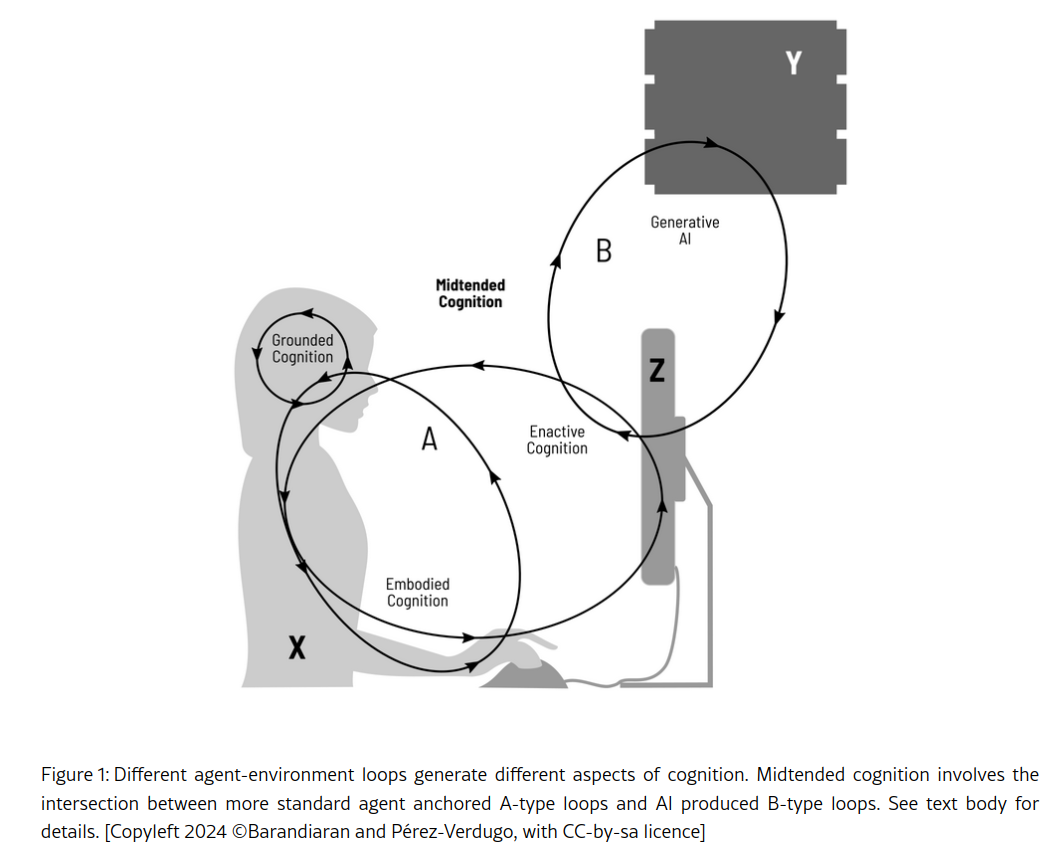
Did you ever experience the situation in which a human provided you with the word you were struggling to find out, accepted the suggestion, made it your own, and kept talking? Well, it happens that generative AI technologies are expanding this phenomenon to unprecedented levels. In this paper we start thinking about the consequences. To do so our work introduces the novel concept of «generative midtended cognition.» This term describes a hybrid cognitive process where generative AI becomes part of human creative agency, enabling interactions that sit between intention and extension: thus midtention. With AI’s ability to iteratively generate complex outputs, «midtended» cognition reflects the creative process where humans and AI co-generate a product, shaping the outcome together (see figure below). We explicitly define midtended cognition as follows:

Given a cognitive agent X, a generative system Y (artificial or otherwise) and cognitive product Z, midtension takes place when generative interventions produced by Y become constitutive of the intentional generation of Z by X, whereby X keeps some sense of agency or authorship over Z.
For those interested in cognitive science, philosophy of mind, or the implications of generative AI, this paper offers a theoretical basis to understand the cognitive depth of these human-AI interactions. Beyond classical extended, enactive and material cognition approaches, we suggest that generative AI initiates a form of cognition closer to social interactions than classical extended cognition approaches to technology. Yet, interacting with a generative AI is not itself a social interaction stricto sensu. It is something new. In order to get a better grasp on this novelty, we introduce and analyse two dimensions of “width” (sensitivity to context) and “depth” (granularity of interaction).

Given the unique generative power of these technologies and the hybrid forms of human-environment interactions they make possible, it’s essential to address both the promising potential and the ethical challenges they introduce. The paper explores multiple scenarios, from authenticity risks to the spectre of cognitive atrophy. But perhaps, it points out to a new concept we find particularly revealing and worth a follow-up paper to develop in depth: that of the economy of intention. We have previously analysed the concept of the economy of attention, an economic driver of contemporary social order and disorders. The phenomenon of Midtended Cognition might well move cognitive capitalism a step forward into a deeper commodification of the mind: not only the information that captures our attention, but the very intentional plans, creations, and projects we make «our own» might now be vulnerable to corporate injection.

ABSTRACT: This paper introduces the concept of  “generative midtended cognition”, that explores the integration of generative AI technologies with human cognitive processes. The term «generative» reflects AI’s ability to iteratively produce structured outputs, while «midtended» captures the potential hybrid (human-AI) nature of the process. It stands between traditional conceptions of intended creation, understood as steered or directed from within, and extended processes that bring exo-biological processes into the creative process. We examine the working of current generative technologies (based on multimodal transformer architectures typical of large language models like ChatGPT), to explain how they can transform human cognitive agency beyond what the conceptual resources of standard theories of extended cognition can capture. We suggest that the type of cognitive activity typical of the coupling between a human and generative technologies is closer (but not equivalent) to social cognition than to classical extended cognitive paradigms. Yet, it deserves a specific treatment. We provide an explicit definition of generative midtended cognition in which we treat interventions by AI systems as constitutive of the agent’s intentional creative processes. Furthermore, we distinguish two dimensions of generative hybrid creativity: 1. Width: captures the sensitivity of the context of the generative process (from the single letter to the whole historical and surrounding data), 2. Depth: captures the granularity of iteration loops involved in the process. Generative midtended cognition stands in the middle depth between conversational forms of cognition in which complete utterances or creative units are exchanged, and micro-cognitive (e.g. neural) subpersonal processes. Finally, the paper discusses the potential risks and benefits of widespread generative AI adoption, including the challenges of authenticity, generative power asymmetry, and creative boost or atrophy.

PhD studentship opportunity

If you want to do a PhD with me or within the Outagencies project I lead, we have just opened a PhD studentship grant application for a 4 year scholarship. Here is some relevant information:

SUMMARY: Opportunity to join us at the IAS-Research Center for Life, Mind, and Society [https://ias-research.net] at the University of the Basque Country (San Sebastián) for a PhD studentship within the “Outagencies: Varieties of autonomous agency across living, humanimal, and technical systems” project [https://outonomy.net/project-description/]: an interdisciplinary exploration of agency across philosophy, biology, AI, and social sciences. We welcome passionate candidates from any background aligned with our research themes, who bring strong motivation, English proficiency, and a robust academic profile.
Deadline: November 18th, 2024
Pre-submission here: https://forms.gle/AGAHu6osrSUJ4Bxd9
Official submission here: https://www.ehu.eus/es/web/ikerketaren-kudeaketa/-/fpi-2024_upv_ehu
Salary: €19,500-€25,000 annually during 4 years (salary increases every year)
Duration: 4 years starting early 2025
More updated information: https://outonomy.net/?p=335

Welcome to my research site

Welcome to my research website. Most of my contributions are made in the form of publications in journals, books or conference proceedings. Please visit the publication page to see the full list of publications (all downloadable). You can also visit my Research pages where I summarize my research lines. Ocasionally, I write posts with some ideas, material, or to announce some publication or changes in my academic life. See below. And welcome.

Seguir leyendo «Welcome to my research site»

Autonomy and Enactivism

Screenshot_enactivism-autonomy
I have finished the last revision of journal paper entitle «Autonomy and Enactivism«. It explores the conceptual tension between the concept of autonomy (self-organized closure of neural activity) and the sensorimotor constitution of cognition. I have long witnesses a generalized confusion, whose roots I explore in the paper, between two major schools of enactivism (the cognitive science paradigm that focuses on sensorimotor coupling and self-organized dynamics of brain, body and environment). On the one hand what I have called «sensorimotor enactivism», a school that has gained momentum thanks to the work of Alva Noë and Kevin O’Regan on sensorimotor contingencies. On the other hand what I have called «autonomist enactivism» with a particular focus on biological embodiment and the self-organized nature of brain and body. The gap between both schools has being growing recently, partly motivated by the lack of a clear notion of sensorimotorly constituted neurodynamic autonomy. Building upon the work I have been doing with my colleagues (Di Paolo, Buhrman, Santos, Aguilera and Bedia) during the last years I hope to have contributed to the compatibility and mutual reinforcement between both schools of thought. It is a long paper, and the contribution does not limit to a historical or contingent dispute between schools of thought: the reconciliation demands to develope a theory of sensorimotor autonomous agency and touches upon foundational aspects of cognitive science, from the emergence of norms to the epistemology of mechanistic explanations.

Seguir leyendo «Autonomy and Enactivism»

New IAS-Research site

Just finished developing the new site for IAS-Research Centre for Life, Mind, and Society. I hope it will be really useful to improve visibility, dissemination and internal coordination of research activity. We used WordPress as a platform with lots of very useful plugins that help generate publication lists, event’s calendars, etc. Thanks to Thomas Buhrmann for his valuable contributions to the site and GISA for the deep server infrastructure.

The Future of the Embodied Mind

We have just started the eSMCs Summer School entitled The Future of the Embodied Mind. The discussion is already taking place both online and during the conference. Check out the website for more information and resources. Very exciting discussions going on, also a lot of work but the outstanding quality of speakers and participants is worth the effort.

Postdoc at CREA – CNRS / Polytechnique and ISC-PIF, in Paris

Already integrated in my new working environment: Paris! I have my base camp at CREA (Centre de Recherche en Épistémologie Appliquée), an interdisciplinary research center that is part of École Polytechnique and the CNRS, but I will also participate and collaborate at the Complex Systems Institute (ISC-PIF). I am already co-organizing the Theoretical Biology Seminars – Séminaire de Biologie Théorique, and I hope to start collaborating on cognitive science research soon.

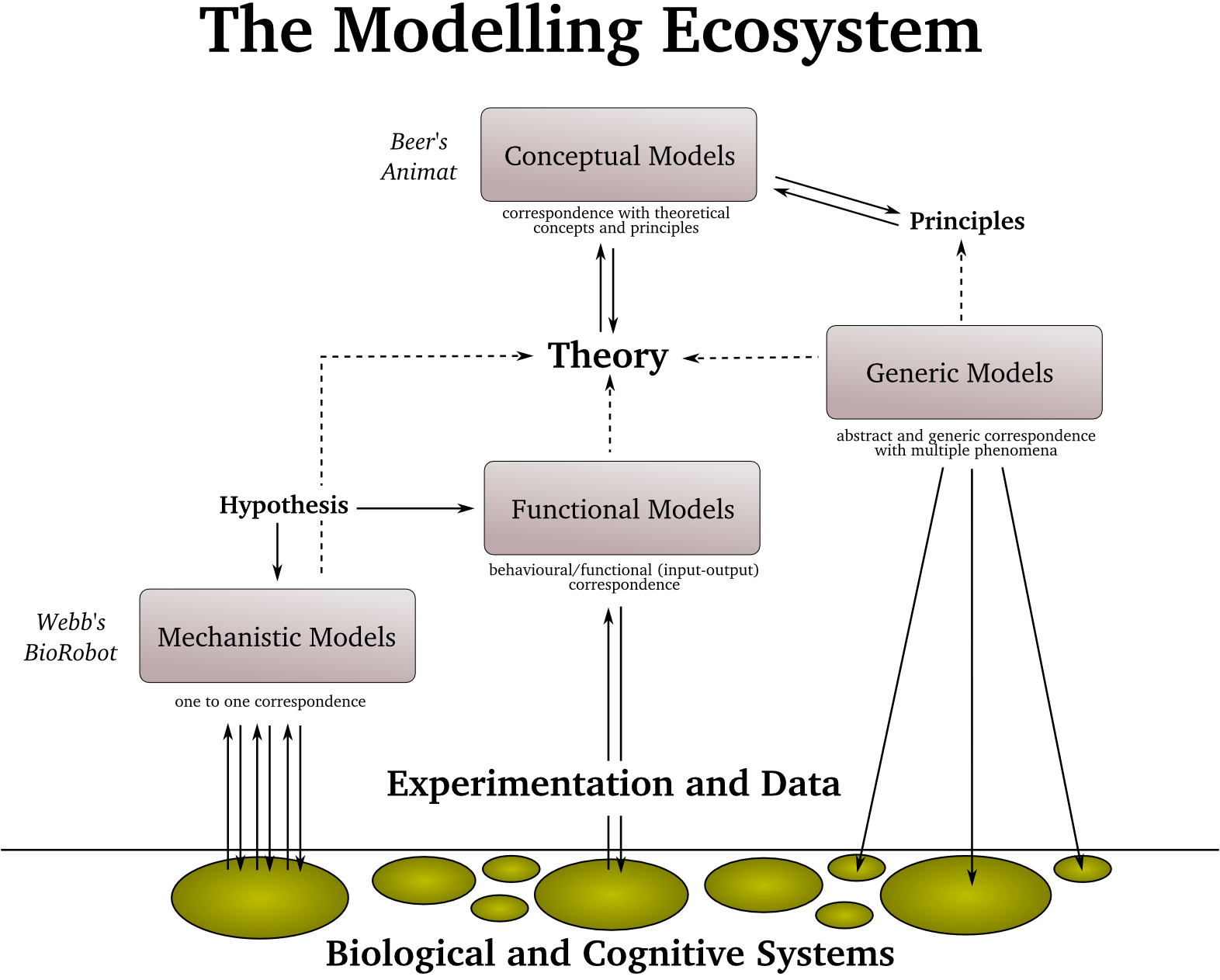
Animats in the Modelling Ecosystems (Response to Barbara Webb)

The Journal of Adaptive Behavior has recently published a target article by Barbara Webb entitled «Animats vs. Animals». I was invited to write a critical response to her paper and joined Anthony Chemero to defend a variety of models in science, ranging from the most concrete to the most abstract.

types_of_models

Seguir leyendo «Animats in the Modelling Ecosystems (Response to Barbara Webb)»

Defining Agency

I have just recently submitted the last version for publication of a new paper, together with Ezequiel Di Paolo and Marieke Rohde: Defining Agency. Individuality, Normativity, Asymmetry and Spatio-temporality in Action, to be published soon on a special issue on Agency edited by Mareke Rohde and Takashi Ikegami on Adaptive Behavior journal.

defining_agency_screenshot

Seguir leyendo «Defining Agency»

Post-Doc at the University of Sussex

I recently got a postdoc grant from the Spanish Ministry of Education and Science to work at the Centre for Computational Neuroscience and Robotics, at the University of Sussex. Check out my Postdoc project: «Artificial Mental Life. A study of Brain­-Body­-World integration through neurocognitive robotics«.

university_of_sussex_old

Seguir leyendo «Post-Doc at the University of Sussex»