Generative Midtentionality: How AI could change intentionality

Barandiaran, X. E., & Pérez-Verdugo, M. (2025). Generative midtended cognition and Artificial Intelligence: Thinging with thinging things. Synthese, 205(4), 1–24. https://doi.org/10.1007/s11229-025-04961-4

Previous preprint available:

I really do think with my pen, because my head
often knows nothing about what my hand is writing

WITTGENSTEIN

I’m excited to share a recent publication co-authored with Marta Pérez-Verdugo titled Generative Midtended Cognition and Artificial Intelligence: Thinging with Thinging Things. This paper represents an initial step in our broader exploration of how generative AI transforms human cognitive agency in ways that traditional frameworks of extended cognition fall short of capturing.

Did you ever experience the situation in which a human provided you with the word you were struggling to find out, accepted the suggestion, made it your own, and kept talking? Well, it happens that generative AI technologies are expanding this phenomenon to unprecedented levels. In this paper we start thinking about the consequences. To do so our work introduces the novel concept of «generative midtended cognition.» This term describes a hybrid cognitive process where generative AI becomes part of human creative agency, enabling interactions that sit between intention and extension: thus midtention. With AI’s ability to iteratively generate complex outputs, «midtended» cognition reflects the creative process where humans and AI co-generate a product, shaping the outcome together (see figure below). We explicitly define midtended cognition as follows:

Given a cognitive agent X, a generative system Y (artificial or otherwise) and cognitive product Z, midtension takes place when generative interventions produced by Y become constitutive of the intentional generation of Z by X, whereby X keeps some sense of agency or authorship over Z.
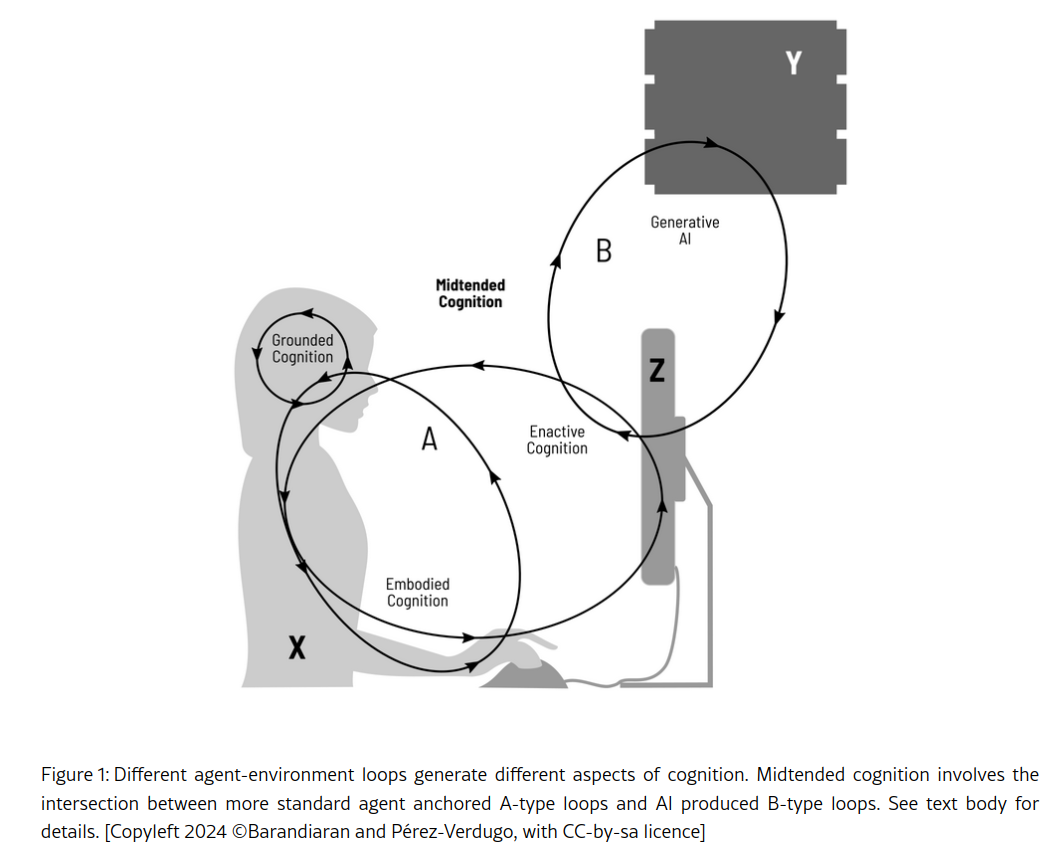
For those interested in cognitive science, philosophy of mind, or the implications of generative AI, this paper offers a theoretical basis to understand the cognitive depth of these human-AI interactions. Beyond classical extended, enactive and material cognition approaches, we suggest that generative AI initiates a form of cognition closer to social interactions than classical extended cognition approaches to technology. Yet, interacting with a generative AI is not itself a social interaction stricto sensu. It is something new. In order to get a better grasp on this novelty, we introduce and analyse two dimensions of “width” (sensitivity to context) and “depth” (granularity of interaction).

Given the unique generative power of these technologies and the hybrid forms of human-environment interactions they make possible, it’s essential to address both the promising potential and the ethical challenges they introduce. The paper explores multiple scenarios, from authenticity risks to the spectre of cognitive atrophy. But perhaps, it points out to a new concept we find particularly revealing and worth a follow-up paper to develop in depth: that of the economy of intention. We have previously analysed the concept of the economy of attention, an economic driver of contemporary social order and disorders. The phenomenon of Midtended Cognition might well move cognitive capitalism a step forward into a deeper commodification of the mind: not only the information that captures our attention, but the very intentional plans, creations, and projects we make «our own» might now be vulnerable to corporate injection.

ABSTRACT: This paper introduces the concept of  “generative midtended cognition”, that explores the integration of generative AI technologies with human cognitive processes. The term «generative» reflects AI’s ability to iteratively produce structured outputs, while «midtended» captures the potential hybrid (human-AI) nature of the process. It stands between traditional conceptions of intended creation, understood as steered or directed from within, and extended processes that bring exo-biological processes into the creative process. We examine the working of current generative technologies (based on multimodal transformer architectures typical of large language models like ChatGPT), to explain how they can transform human cognitive agency beyond what the conceptual resources of standard theories of extended cognition can capture. We suggest that the type of cognitive activity typical of the coupling between a human and generative technologies is closer (but not equivalent) to social cognition than to classical extended cognitive paradigms. Yet, it deserves a specific treatment. We provide an explicit definition of generative midtended cognition in which we treat interventions by AI systems as constitutive of the agent’s intentional creative processes. Furthermore, we distinguish two dimensions of generative hybrid creativity: 1. Width: captures the sensitivity of the context of the generative process (from the single letter to the whole historical and surrounding data), 2. Depth: captures the granularity of iteration loops involved in the process. Generative midtended cognition stands in the middle depth between conversational forms of cognition in which complete utterances or creative units are exchanged, and micro-cognitive (e.g. neural) subpersonal processes. Finally, the paper discusses the potential risks and benefits of widespread generative AI adoption, including the challenges of authenticity, generative power asymmetry, and creative boost or atrophy.

Transforming agency. On the mode of existence of Large Language Models.

WTF is ChatGPT? Not an (autonomous) agent but a library-that-talks, and is changing your life

I have been working with Lola Almendros for almost two years on this paper. It has taken looong to finish. But it is now available as a preprint. Here is a quote of one of the central ideas:

ChatGPT operates as a gigantic (…) library-that-talks, enabling a dialogical engagement with the vast corpus of human knowledge and cultural heritage it has ‘internalized’ (compressed on its transformer multidimensional spaces) and that it is capable of recruiting effectively in linguistic exchange. The machine’s interlocution, though devoid of personal intentionality, bears the trace of human experience as transposed into digitalized textuality. The purpose-structured and bounded automatic interlocution, however, can be experienced as a genuine dialogue by the human subject.

Generative technologies, and more specifically, Large Language Models (like ChatGPT, Gemini, Mixtral, Llama, or Claude) are rapidly expanding and populating our everyday toolbox and interaction space. If philosophy is understood as the practice of crafting (new) concepts to (better) organize our life… we have some job to do! Many conceptualize LLMs as mere “dumb statistical engines”, others as “sentient persons” … But what are they exactly? We know they are capable of surpassing existing intelligence benchmarks while, at the same time, failing to solve some kinds of simple puzzles.

Inspired on Simondon’s insights that part of our alienation regarding technology has to do with our lack of understanding of what technical object are and how they work, this paper deepens into the architecture, processing and systemic couplings under which LLMs (like ChatGPT) operate. We contrast this operational structure with those of living agents to conclude that LLMs fail to meet the requirements that characterized them. If not as agents, then… how to categorize LLMs? Here is one proposal:

[M]ore than a self-bootstrapped Artificial Intelligence, ChatGPT, as an interlocutor automaton, is a computational proxy of the human collective intelligence externalized into a digitalized written body. It is, in turn, shaped and taken care of by hundreds of human and non-human lives. […] This happens not just at a contextual level or as an operational environment, but at a constitutive level. No LLM is an island. And their performative power, and derived agentive capacities (if any), inherently rest on human and planetary scale life.

Moreover:

LLMs display capacities that effectively mobilize human intelligence as embodied in massive textuality, affectively mobilize human intelligence in conversation, and can activate forms of hybrid agency previously unavailable for human intelligence.

And yet, the scale of LLM operations is immense and beyond explainable human capacity to fully conceptualized. For example, GPT-3 was trained on 570 GB of text data, equivalent to around 2 million books, which would take a human over 500 years to read. Moreover, processing tasks performed by LLMs involve computational operations on a scale that would take a human expert millions of years to replicate if carried out step-by-step. We conclude:

By a digitality that deep, it is reasonable to hold that the boundary between invention and discovery, between artifact and nature, between engineering and science is somewhat blurred. We have built LLMs as much as we have discovered their emergent capabilities.

This paper is a preliminary (ontological) analysis of LLMs and transformer technologies and their coupling with human agency. Our goal is to address the deep technopolitical challenges and opportunities that this type of devices (and their social-ecological support networks) have opened.

ABSTRACT: This paper investigates the ontological characterization of Large Language Models (LLMs) like ChatGPT. Between inflationary and deflationary accounts, we pay special attention to their status as agents. This requires explaining in detail the architecture, processing, and training procedures that enable LLMs to display their capacities, and the extensions used to turn LLMs into agent-like systems. After a systematic analysis we conclude that a LLM fails to meet necessary and sufficient conditions for autonomous agency in the light of embodied theories of mind: the individuality condition (it is not the product of its own activity, it is not even directly affected by it), the normativity condition (it does not generate its own norms or goals), and, partially the interactional asymmetry condition (it is not the origin and sustained source of its interaction with the environment). If not agents, then … what are LLMs? We argue that ChatGPT should be characterized as an interlocutor or linguistic automaton, a library-that-talks, devoid of (autonomous) agency, but capable to engage performatively on non-purposeful yet purpose-structured and purpose-bounded tasks. When interacting with humans, a «ghostly» component of the human-machine interaction makes it possible to enact genuine conversational experiences with LLMs. Despite their lack of sensorimotor and biological embodiment, LLMs textual embodiment (the training corpus) and resource-hungry computational embodiment, significantly transform existing forms of human agency. Beyond assisted and extended agency, the LLM-human coupling can produce midtended forms of agency, closer to the production of intentional agency than to the extended instrumentality of any previous technologies.

Media interventions around AI: collective intelligence, undead gods, and democratization

DALL-E 3 generated image of a group of people confronting the future of AI in nature
Human collective intelligence facing an AI mediated future.
[Image generated with DALL-E 3]

My life has come close to AI in different moments. I wrote my first AI program in 1999 (in Prolog), my first neural network in 2001. But I have mostly remained as an AI sceptic, more devoted to explore how Artificial Life models can partially disclose some of the intricate mysteries of life (biological, psychological, and social) than to the possibility of computer programs achieving anything close to human-level linguistic competence. I started to feel that something was changing in AI research when DeepMind first claimed to have succeeded in playing Go and, more importantly, in playing different computer games, using human controls (e.g. first-person visuomotor feedback), and without knowing or encoding the game rules in advance (Schrittwieser et al. 2020).

Philosophy has spent the last couple of centuries announcing the death of God, it is now time to remember that AI is not alive.

I could smell something was about to change quickly. Other indicators were already clearly visible (big tech buying small AI firms, among others). So, when I read that a company called OpenAI was accepting requests to use their GPT3 API, I rapidly signed for early access. I got hands onto GPT the 26th February 2021. I spent almost three days in a row hooked to my computer. I couldn’t believe what I was experiencing. Despite the lack of fine-tuning, the numerous hallucinations, the confusing interface (I had to discover what “prompting” meant for myself), … the experience was absolutely overwhelming. On my understanding of what computer could do, they simply were not supposed to do that 🙂

AI-driven corporation are already the new Gods, showing themselves as living on the clouds, as omniscient, omnipotent, transcendent, mysteriously incomprehensible, and biased, like any other God before

Parallel to my research on philosophy of mind and cognitive science, I have been a tech activist for a couple of decades. I could feel that what I just witnessed, talking to a computer program that wasn’t playing the silly psychoanalytic trick, was about to “change everything”. Two years latter I am still not surprised, although I start to be tired, of hearing it. And they are good reasons for it.

AI is really a compressed form of digitized and automatized Collective Intelligence

It is still difficult to stop thinking on the philosophical, political and, at large, social consequences of the changes to come (none of which, by the way, should make us forget that caring for human lives, and for life on earth must, be the absolute priority for everyone, that there is no AI that is going to save us).

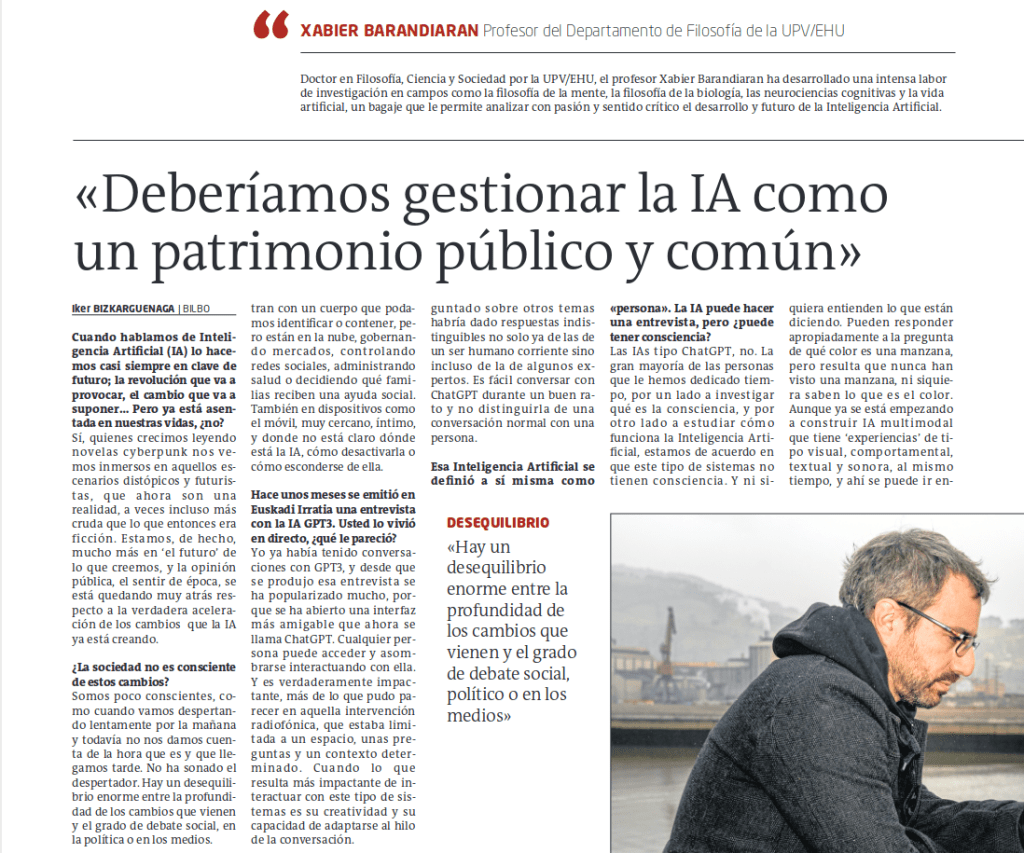
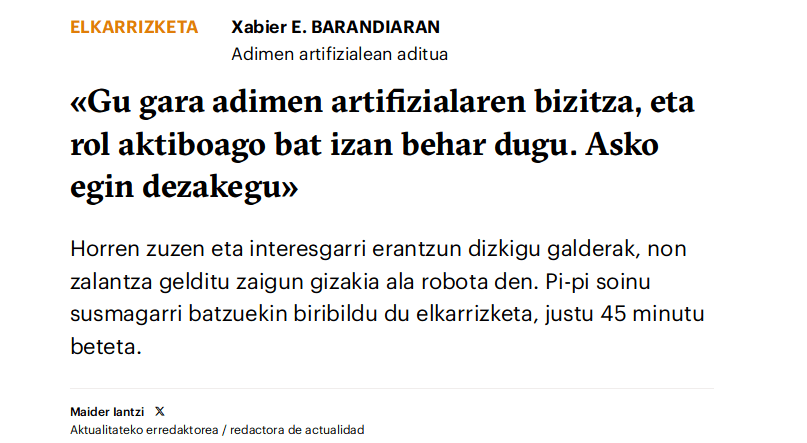
During these couple of years I have been asked to participate in different talks, interviews, round-panels, etc. And 2023 was particularly active. Collected here, you can find a number of media interventions in English, Spanish and Basque, where I elaborate on different aspects of the ongoing AI «revolution». In these interventions, I have aimed to explore the ethical, societal, and technological dimensions of AI, reaching out to diverse audiences. But they all touch upon 3 main ideas:

  1. If not all, at least the most recently successful AI, is really a compressed form of digitized and automatized Collective Intelligence, that is the structured result of large scale human cognitive live sedimented in the huge mathematical apparatus sustaining AI, on the gigantic corpus of textual and visual data used during training and the huge amounts of cognitive and emotional labour put on reinforcement learning and curating the data.
  2. The transformations to come are so deep that, in order to understand and cope with it, we might only rely on socio-cultural resources coming from religious studies and the transformations that the invention of writing brought to human life. AI-driven corporation are already the new Gods, showing themselves as living on the clouds, as omniscient, omnipotent, transcendent, mysteriously incomprehensible, and biased, like any other God before. Philosophy has spent the last couple of centuries announcing the death of God, it is now time to remember that AI is not alive. And yet, for years to come, we might not be able to live without AI. In a sense, they are the new undead Gods.
  3. We are the life of AI, and the complexity and power of these new technologies cannot rest on the hands of private corporate industries. Democratizing AI is an urgent task. It already belongs to us, we need to reclaim it back. Beyond regulation, political action need to take innovative agency. It is not about acceleration or deceleration, it is about steering our futures.

1. Interventions in English

2. Interventions in Spanish

3. Interventions in Basque