Outonomy book is out!

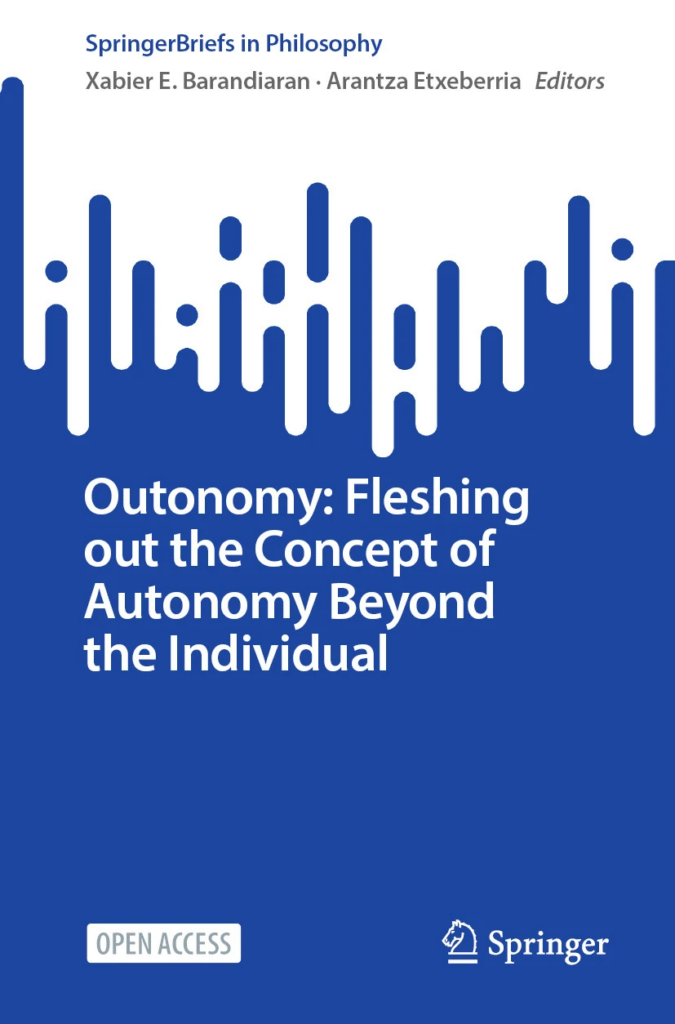
I am very happy to announce the publication of Outonomy: Fleshing out the Concept of Autonomy Beyond the Individual, edited by Arantza Etxeberria and me. This book is the unified and integrated result of our the research project of the same title lead by myself and Leonardo Bich that finished over a year ago. The book gathers a rich, cross-disciplinary exploration of autonomy that moves beyond the classic, self-sufficient, abstract, rational and detached model of the individual we inherited from modernity. Instead, it develops the concept of outonomy to capture how autonomy is constituted through relations: with environments, other agents, technologies, institutions, and social-ecological systems.
This image has an empty alt attribute; its file name is image-675x1024.png

Why “Outonomy”?

Autonomy has long been central to modern thought, ethics, and the life sciences. But many contemporary debates across philosophy of biology, cognitive science, medicine, technology studies, and political theory show that the boundaries and concerns of the individual more far beyond itself. The outonomy framework responds to this situation by offering a more interactional and environmentally situated account of self-governance and normativity.

In the opening chapter, Barandiaran and Etxeberria outline 4 key properties that help articulate this shift:

  • Interactivity
  • Collectivity
  • Extensionality
  • Environmentality

Along two fundamental dimensions:

  • Integration
  • Sustainability

Together, these ideas reframe autonomy as something that emerges across scales of interaction and dependence, rather than something sealed within an isolated individual.

A structured journey across life, mind, technology, and politics

The volume is organized into four parts that build a coherent arc while engaging multiple domains:

Part I: Theoretical Insights
Foundational chapters clarify the conceptual stakes of outonomy and rethink control and organization in biological systems.

Part II: The Fabric of Life
Chapters address environments and asymmetries, the origins of life, reproduction, and a compelling application to menstrual health.

Part III: The Psychic Self and Its Environment
Here the outonomy perspective extends into psychiatry, salutogenesis, and pain, emphasizing embodied and relational normativity.

Part IV: Technology, Ecology & Politics
These chapters explore technocomplexity, the limits of autonomy in social-ecological systems, subjects-in-common, and mindshaping in relation to adaptive preferences.

Co-authored chapters

I have co-edited the book, and co-authores three chapters:

  • Barandiaran, X. E., & Etxeberria, A. (2026). Outonomy, the Very Idea. In X. E. Barandiaran & A. Etxeberria (Eds.), Outonomy: Fleshing out the Concept of Autonomy Beyond the Individual (pp. 3–12). Springer Nature Switzerland. https://doi.org/10.1007/978-3-032-05501-9_1
    • Here we introduce the concept of Outonomy as an attempt to overcome some of the limitations of the concept of autonomy as inherited from modernity.
  • Cabello, V., Merlo, A., Mancilla, M., Siqueiros, J. M., & Barandiaran, X. E. (2026). Autonomy and Its Limits in Social-Ecological Systems. In X. E. Barandiaran & A. Etxeberria (Eds.), Outonomy: Fleshing out the Concept of Autonomy Beyond the Individual (pp. 121–130). Springer Nature Switzerland. https://doi.org/10.1007/978-3-032-05501-9_12
    • In this chapter, we approach the notion of autonomy at its largest planetary scale. Social-ecological systems are in need of a deep exercise of autonomy as self-limitation and care if we are to avoid the increasing destruction of living diversity and flourishing life on earth.
  • Calleja-López, A., Pérez-Verdugo, M., & Barandiaran, X. E. (2026). Autonomy and Technology: From Instrumentalism to Technocomplexity. In X. E. Barandiaran & A. Etxeberria (Eds.), Outonomy: Fleshing out the Concept of Autonomy Beyond the Individual (pp. 111–120). Springer Nature Switzerland. https://doi.org/10.1007/978-3-032-05501-9_11
    • This chapter captures the dialectical moments that tie autonomy and technology, from the naïve, yet widespread, instrumental use to the techno-complex participatory constitution of our extended life, passing through the persistent thread of an increasingly autonomous techno-economic system that subsumes and alienates human autonomy.

A collaborative research effort

The book emerges from sustained work within the Outonomy research network and related projects, with authors actively reviewing and strengthening each other’s contributions. It also benefits from external reviewers who helped refine the final manuscript.

Download and read the book or some of its chapters:
Outonomy: Fleshing out the Concept of Autonomy Beyond the Individual
Decidim Book is out!

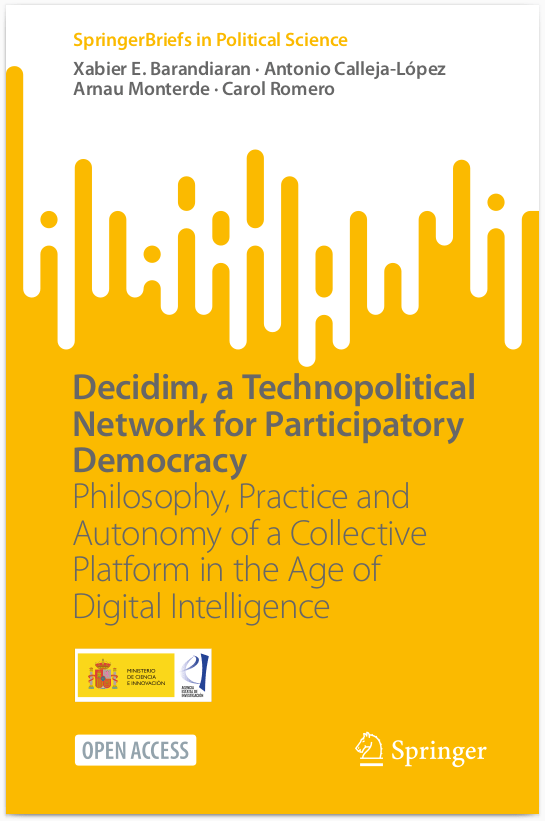
I am proud to announce the Decidim Book:

Barandiaran, X. E., Calleja-López, A., Monterde, A., & Romero, C. (2024). Decidim, a Technopolitical Network for Participatory Democracy. Philosophy, Practice and Autonomy of a Collective Platform in the age of Digital Intelligence. Springer. https://link.springer.com/book/9783031507830

It has taken almost 6 years since we started writing what, at the time, we called Decidim’s White Paper. Some drafts of the early book have been circulating ever since, but we never completed the story. We were very busy doing Decidim. Years past, the project settled, and we took the time (thanks Antonio for offering us the great opportunity to push the book forward in Arantzazu!) to finally write it.

The table of contents of the book makes for a good summary:

  1. Decidim: A Brief Overview
    • Here we summarize the nature of the project, its current impact, its history and why the project was born in the context of cognitive capitalism and the decline of neoliberal «democracies» on the one hand, and the dawn of digital commons and radical democracy on the other.
  2. The Political Plane: Decidim and the Vision of a Radically Democratic Society
    • This part is the most theoretical, we review contemporary social and democratic theory to explain the type of democratic vision that Decidim is aimed to achieve.
  3. The Technopolitical Plane: Decidim as a Democratic Software Paradigm
    • This chapter covers perhaps the most original aspect of the project, its careful technopolitical crafting, the way in which technical details are assembled to produce specific types of political effects and how the community embodies recursively those technical and political mechanism on its own constitution.
  4. The Technical Plane: The Fabric of an Infrastructure
    • As the title anticipates, this is the most technical description of how the software, the community, the legal framework and the
  5. A Technopolitical Network for Participatory Democracy: The Future of a Collective Platform
    • This is perhaps the most philosophical and speculative of all chapters. Recapitulating the content of the entire book, we project past, present and future challenges and provide a reading of what Decidim is and could be.

As an academic publication the book own much to the work of IAS-Research Group, and its decades of study of the autonomy of the living, now transposed to the autonomy of sociotechnical hybrids like this project: the democratic autonomous assemblage of the organic and the inorganic. The project Outonomy partially financed the publication with Open Access CreativeCommons By-SA licence.

I leave you with two quotes of the conclusions (chapter 5):

At the beginning of this book, we made clear that a project like Decidim might be necessary, but is certainly not sufficient for advancing democracy. There is no future for Decidim or for democracy without a deep transformation of the material living conditions, the social (and global) inequalities and the myriad of oppressive structures that are reproduced every day. Decidim should leave no room for techno-solutionism (the idea that social or political problems have technological solutions). It should equally debunk techno-fatalism. It already has. Decidim is an example of how it is possible to create and deploy a large-scale, radically transformative software project out of the platform capitalist model. An important challenge to any radical democratization process (particularly when addressing struggles) is the problem of coordination of collective action. This is where Decidim should be ready to become a valuable infrastructure, which may then contribute to address the challenges of complexity and conflictuality of society. (p. 124-5)

As a coagulation of hundreds of Metadecidim debates, the movement recursivity includes this very text; and so recrafts thinking, action, and, crucially, the frequently forgotten (re)production. We began suggesting that this book aims to think through Decidim after we did take part in it. Actually, we were thinking through Decidim as we were doing it, and Decidim keeps making and thinking itself today. With this book we came to recapitulate and throw out several lines of flight that show how Decidim has aimed to retie technology, politics, economics, ecology and beyond, and that flight has the form of a living animal: it is the flight of a cyborg owl. The cyborg owl can be taken as an imaginary ode to our animal and our technical, increasingly post-natural and allegedly post-humanist condition. Yet this owl is not the symbol of a Hegelian self-reflective movement that satisfies itself in contemplation, but the owl that flies in the evening to bring, back to the nest, the provision to sustain a new day. It is reflective action and active reflection aimed at producing and reproducing flourishing forms of life. (p.130-1)