What Does It Mean for a Body (part) to Fail?

J.M.W. Turner's Painting entitled "Tintern Abbey" (1794)
J.M.W. Turner, «Tintern Abbey» (1794) from Wikipedia Commons

I just published a new paper:

Barandiaran, X. E. (2025). Organizational Accounts of Malfunction: The Dual-Order Approach and the Normative Field Alternative. Biological Theory. https://doi.org/10.1007/s13752-025-00500-z

Why does a heart attack count as a malfunction, but a volcanic eruption doesn’t? What makes one failure meaningful while the other is merely an outcome of physical laws? This is a foundational question in philosophy. It conditions the nature of explanations in philosophy of science, the autonomy of biology, the concepts of adaptiveness, health or well-being, the possibility of meaning emerging in nature, or, ultimately, our own judgement.

At the most basic level, at the heart of biological explanation, lies the idea of function. Your heart functions to pump blood; your kidneys function to filter it. But the idea of function implies something deeper: that things can go wrong. If a function can succeed, it can also fail.

“There is no function if there is no room for failure or possibility of malfunctioning, otherwise the notion of function would add nothing to the mere description of a process,” (p. 2)

There are different accounts of (mal)function in the philosophical pool. Most classical theories of function fall into two camps: biostatistical and etiological. The first (Boorse) defines dysfunction as statistical deviance from the norm. The second (Millikan, Neander) grounds function in evolutionary history—traits fail if they don’t do what they were selected to do. An alternative to these accounts is the so-called organizational account. It states that a trait malfunctions when it fails to contribute to the self-maintenance of the system it belongs to, in the manner that other parts dynamically (functionally) presupposes it to do so. I have been discontinuously working on this theory since my MSc thesis (2002), then with Alvaro Moreno (2008), then with Ezequiel Di Paolo and Marieke Rohde (2009), and lastly with Mattew Egbert (2014).

The canonical definition of the organization approach to function is due to Mossio, Saborido and Moreno, to be latter reframed in Moreno and Mossio’s book “Biological Autonomy” in 2015. This paper is somehow a (very) late response to some problems inherent on their specific understanding of malfunction. I have named it the “dual-order” approach because it defines malfunction as a failure of a trait to respond to a regulatory command to switch between “regimes” of self-maintenance. I suggest we need to take a different route (advanced and formalized in Barandiaran and Egbert 2014). My alternative does away with the need for two orders of norms, and proposes a gradual (non-binnary) account of function. It analyses malfunction dynamically, in terms of how a trait’s activity aligns with what is minimally required for maintaining viability. I use the concept of a “normative field”—a gradient that specifies, at each point, how a variable (like heart rate or food intake) needs to change to avoid system collapse.

“A trait operates normatively when its effects on the viability space correlate positively with the normative field”. (p. 8)

With this approach, it is possible to distinguish between different types of dysfunction (see figure panel d):

  • Subfunction: the trait works, but too slowly or insufficiently.
  • Malfunction: the trait works against what’s required.
  • Nonfunction: the trait fails to operate at all when needed.

Fig. 2 Bifurcation diagram of a system, depicting the incoming food concentration [F] on the x-axis and the amount of internal metabolite concentration [A] on the y-axis. Subfigure a depicts the tendency of the system to two stable equilibria (solid lines), the death state at [A] = 0 and the viable state (top curved line), an unstable equilibrium is depicted with a dashed line. Tendencies of [A] are depicted with vertical arrows, with a constant supply of [F] the system at point r moves to the stable living or viable equilibrium, while departing from s it evolves to [A] = 0 and dies. Subfigure b displays a partition of the state space into Viable, Precious and Terminal regions derived from the tendencies of [A]. Subfigure c depicts the normative field as the positive change of [F] that is necessary at each point of the precarious region to avoid death. Subfigure d represents 4 different types of trajectories within the viability space: functioning or functional increase of [F] positively correlated with the normative field, malfunctioning modulation of [F] that is not correlated with the normative field and will eventually lead to death, non-functioning trajectories also lead to death by inactivity and subfunctioning trajectories are positively correlated with the normative field (pushing [F] to increase) but fail to save the life of the organism (see text for more details).

This classification captures biological nuance that the dual-order model cannot, such as partial failures within a single regime or regulatory dysfunctions at higher systemic levels.

What I offer is a more parsimonious, gradated, and inclusive framework. Rather than splitting the world into constitutive and regulatory norms, my approach captures both under a unified formalism. Biological systems, after all, are full of gradual regulation, not binary switches. Hormones, enzyme levels, and neuronal excitations rarely flip like light switches—they modulate, fine-tune, oscillate. In short, I argue, the Normative Field Approach provides a robust and flexible model for understanding malfunction.

I conclude with a short metaphysical exhort on the nature of functions that I feel tempted to turn into a full paper: “From an operational perspective, norms appear as conditions of possibility for the organism’s very existence—within an extended present (or across scales of extended presents) that sustain the organization anchoring those norms. This does not exactly render norms epiphenomenal; rather, it suggests an explanation that cuts across both epi- and sub-phenomenal levels. Normativity could be said to be epiphenomenal in the sense that it offers a higher-order normative description of system operations—descriptions that different parts of the system may or may not conform to, to varying degrees. At the same time, it is sub-phenomenal (and thus transcendental in the Kantian sense) insofar as it refers to modes of functioning among parts that constitute the very conditions of possibility for the system’s ongoing existence. For the system to exist as an observable entity here and now, the normative description must already have been satisfied.” (p. 16)

«it suggests an explanation that cuts across both epi- and sub-phenomenal levels.» (p.16)

This way of conceiving (mal)functions has consequences. Particularly if we are to avoid normalizing instrumentations of functionality and dysfunctionality (e.g. by claiming that somebody’s behaviour is dysfuctional because it deviates from statistical normality or from historical competitive selection) and favours instead a system centered, environmentally sensitive, open and singular account of function anchored on the autonomy of the system under care:

“[I]t is ultimately the autonomy of each living organization (in its open and interdependent singularity and becoming) that marks the horizon of normative judgements.” (p.16)

Here is the full paper:
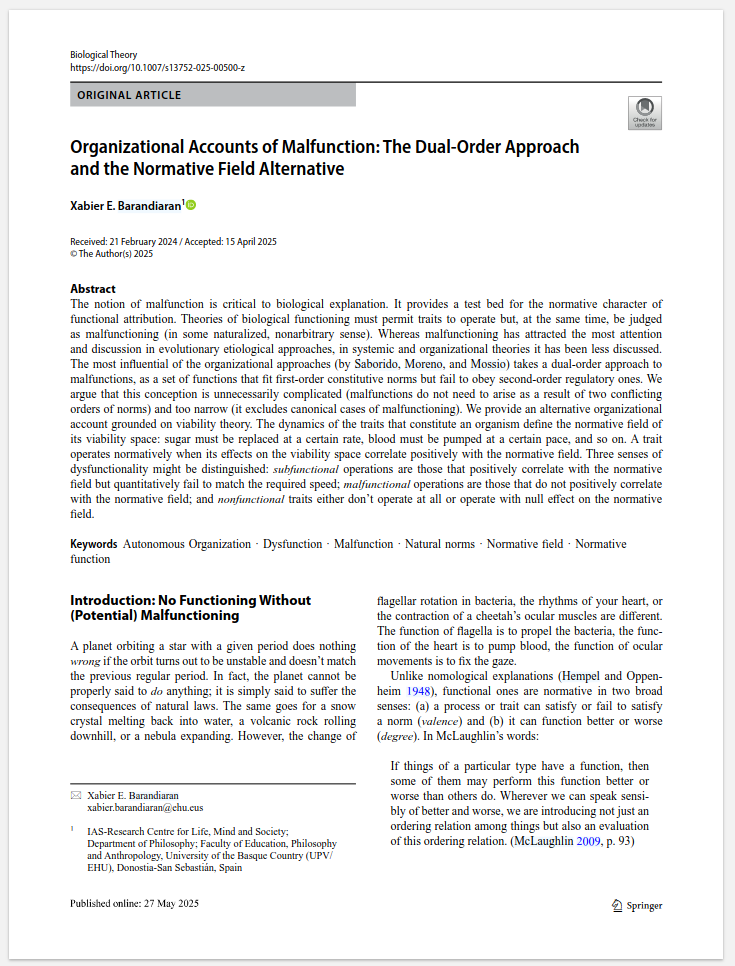
Barandiaran, X. E. (2025). Organizational Accounts of Malfunction: The Dual-Order Approach and the Normative Field Alternative. Biological Theory. https://doi.org/10.1007/s13752-025-00500-z

ABSTRACT: The notion of malfunction is critical to biological explanation. It provides a test bed for the normative character of functional attribution. Theories of biological functioning must permit traits to operate but, at the same time, be judged as malfunctioning (in some naturalized, nonarbitrary sense). Whereas malfunctioning has attracted the most attention and discussion in evolutionary etiological approaches, in systemic and organizational theories it has been less discussed. The most influential of the organizational approaches (by Saborido, Moreno, and Mossio) takes a dual-order approach to malfunctions, as a set of functions that fit first-order constitutive norms but fail to obey second-order regulatory ones. We argue that this conception is unnecessarily complicated (malfunctions do not need to arise as a result of two conflicting orders of norms) and too narrow (it excludes canonical cases of malfunctioning). We provide an alternative organizational account grounded on viability theory. The dynamics of the traits that constitute an organism define the normative field of its viability space: sugar must be replaced at a certain rate, blood must be pumped at a certain pace, and so on. A trait operates normatively when its effects on the viability space correlate positively with the normative field. Three senses of dysfunctionality might be distinguished: subfunctional operations are those that positively correlate with the normative field but quantitatively fail to match the required speed; malfunctional operations are those that do not positively correlate with the normative field; and nonfunctional traits either don’t operate at all or operate with null effect on the normative field.

Generative Midtentionality: How AI could change intentionality

Barandiaran, X. E., & Pérez-Verdugo, M. (2025). Generative midtended cognition and Artificial Intelligence: Thinging with thinging things. Synthese, 205(4), 1–24. https://doi.org/10.1007/s11229-025-04961-4

Previous preprint available:

I really do think with my pen, because my head
often knows nothing about what my hand is writing

WITTGENSTEIN

I’m excited to share a recent publication co-authored with Marta Pérez-Verdugo titled Generative Midtended Cognition and Artificial Intelligence: Thinging with Thinging Things. This paper represents an initial step in our broader exploration of how generative AI transforms human cognitive agency in ways that traditional frameworks of extended cognition fall short of capturing.

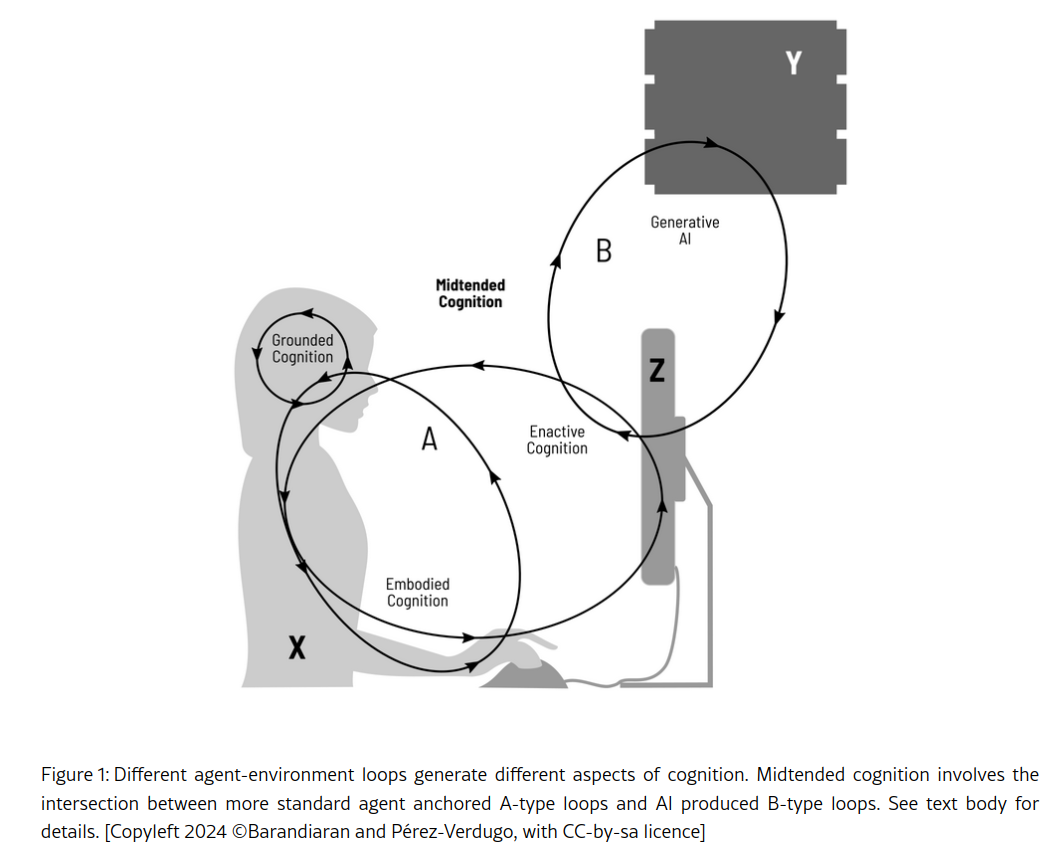
Did you ever experience the situation in which a human provided you with the word you were struggling to find out, accepted the suggestion, made it your own, and kept talking? Well, it happens that generative AI technologies are expanding this phenomenon to unprecedented levels. In this paper we start thinking about the consequences. To do so our work introduces the novel concept of «generative midtended cognition.» This term describes a hybrid cognitive process where generative AI becomes part of human creative agency, enabling interactions that sit between intention and extension: thus midtention. With AI’s ability to iteratively generate complex outputs, «midtended» cognition reflects the creative process where humans and AI co-generate a product, shaping the outcome together (see figure below). We explicitly define midtended cognition as follows:

Given a cognitive agent X, a generative system Y (artificial or otherwise) and cognitive product Z, midtension takes place when generative interventions produced by Y become constitutive of the intentional generation of Z by X, whereby X keeps some sense of agency or authorship over Z.

For those interested in cognitive science, philosophy of mind, or the implications of generative AI, this paper offers a theoretical basis to understand the cognitive depth of these human-AI interactions. Beyond classical extended, enactive and material cognition approaches, we suggest that generative AI initiates a form of cognition closer to social interactions than classical extended cognition approaches to technology. Yet, interacting with a generative AI is not itself a social interaction stricto sensu. It is something new. In order to get a better grasp on this novelty, we introduce and analyse two dimensions of “width” (sensitivity to context) and “depth” (granularity of interaction).

Given the unique generative power of these technologies and the hybrid forms of human-environment interactions they make possible, it’s essential to address both the promising potential and the ethical challenges they introduce. The paper explores multiple scenarios, from authenticity risks to the spectre of cognitive atrophy. But perhaps, it points out to a new concept we find particularly revealing and worth a follow-up paper to develop in depth: that of the economy of intention. We have previously analysed the concept of the economy of attention, an economic driver of contemporary social order and disorders. The phenomenon of Midtended Cognition might well move cognitive capitalism a step forward into a deeper commodification of the mind: not only the information that captures our attention, but the very intentional plans, creations, and projects we make «our own» might now be vulnerable to corporate injection.

ABSTRACT: This paper introduces the concept of  “generative midtended cognition”, that explores the integration of generative AI technologies with human cognitive processes. The term «generative» reflects AI’s ability to iteratively produce structured outputs, while «midtended» captures the potential hybrid (human-AI) nature of the process. It stands between traditional conceptions of intended creation, understood as steered or directed from within, and extended processes that bring exo-biological processes into the creative process. We examine the working of current generative technologies (based on multimodal transformer architectures typical of large language models like ChatGPT), to explain how they can transform human cognitive agency beyond what the conceptual resources of standard theories of extended cognition can capture. We suggest that the type of cognitive activity typical of the coupling between a human and generative technologies is closer (but not equivalent) to social cognition than to classical extended cognitive paradigms. Yet, it deserves a specific treatment. We provide an explicit definition of generative midtended cognition in which we treat interventions by AI systems as constitutive of the agent’s intentional creative processes. Furthermore, we distinguish two dimensions of generative hybrid creativity: 1. Width: captures the sensitivity of the context of the generative process (from the single letter to the whole historical and surrounding data), 2. Depth: captures the granularity of iteration loops involved in the process. Generative midtended cognition stands in the middle depth between conversational forms of cognition in which complete utterances or creative units are exchanged, and micro-cognitive (e.g. neural) subpersonal processes. Finally, the paper discusses the potential risks and benefits of widespread generative AI adoption, including the challenges of authenticity, generative power asymmetry, and creative boost or atrophy.

Personal Autonomy and (Digital) Technology: An Enactive Sensorimotor Framework

I am glad to share this new publication in collaboration with Marta Pérez-Verdugo (first author and main contributor to this paper). This is my first (probably the first?) serious and deep philosophical application of sensorimotor life theories of cognition to digital, and more generally technological, environments. It also brings with it ethical and political implications in the way in which digital environments constraint technopolitical autonomy, and makes a notable contribution to the connection between autonomy in moral philosophy and autonomy in enactive theorizing (thanks to the great work made by Marta). The paper is also very programmatic and foundational, for it characterizes technology and technical behaviour in enactive terms and opens the way to further developments to come. Finally, the paper illuminates the way in which we get so often captured or steered by interface design in digital platforms and how to build autonomy-enhancing digital environments.

Pérez-Verdugo, M., & Barandiaran, X. E. (2023). Personal Autonomy and (Digital) Technology: An Enactive Sensorimotor Framework. Philosophy & Technology, 36(4), 84. https://doi.org/10.1007/s13347-023-00683-y.

ABSTRACT: Many digital technologies, designed and controlled by intensive data-driven corporate platforms, have become ubiquitous for many of our daily activities. This has raised political and ethical concerns over how they might be threatening our personal autonomy. However, not much philosophical attention has been paid to the specific role that their hyper-designed (sensorimotor) interfaces play in this regard. In this paper, we aim to offer a novel framework that can ground personal autonomy on sensorimotor interaction and, from there, directly address how technological design affects personal autonomy. To do this, we will draw from enactive sensorimotor approaches to cognition, focusing on the central notion of habits, understood as sensorimotor schemes that, in networked relations, give rise to sensorimotor agency. Starting from sensorimotor agency as a basis for more complex forms of personal autonomy, our approach gives us grounds to analyse our relationship with technology (in general) and to distinguish between autonomy-enhancing and autonomy-diminishing technologies. We argue that, by favouring/obstructing the enactment of certain (networks of) habits over others, technologies can directly act upon our personal autonomy, locally and globally. With this in mind, we then discuss how current digital technologies are often being designed to be autonomy-diminishing (as is the case of “dark patterns” in design), and sketch some ideas on how to build more autonomy-enhancing digital technologies.

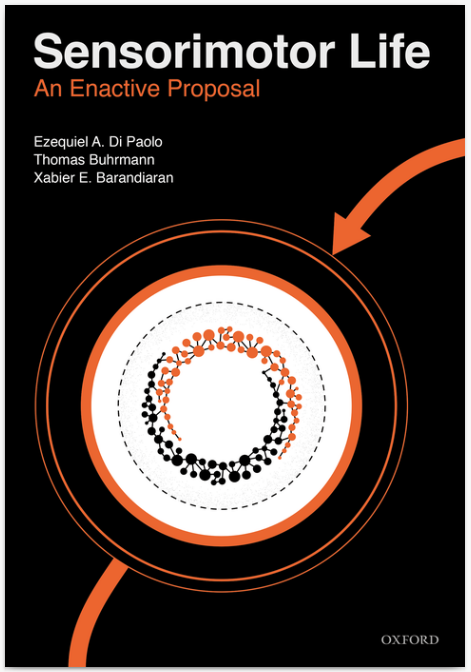
Sensorimotor Life. An Enactive Proposal (the Book)

Cover image of Sensorimotor Life

It has been some time now since we published this book. At the time I was too busy working at Barcelona City Council and could not publish a post on this blog. It is now time to do so.

Chapters 5 and 6 of the book are based on my PhD thesis and I am proud to see it published within the more ellaborate framework of this book.

From the official summary of the book: «Sensorimotor Life draws on current theoretical developments in the enactive approach to life and mind. It examines and expands the premises of the sciences of the human mind, while developing an alternative picture closer to people’s daily experiences. Enactive ideas are applied and extended, providing a theoretically rich, naturalistic account of meaning and agency. The book includes a dynamical systems description of different types of sensorimotor regularities or sensorimotor contingencies; a dynamical interpretation of Piaget’s theory of equilibration to ground the concept of sensorimotor mastery; and a theory of agency as organized networks of sensorimotor schemes, as well as its implications for embodied subjectivity.»

The book is available online in various formats. You can download a PDF version of «Sensorimotor Life. An Enactive Proposal» here.

Seguir leyendo «Sensorimotor Life. An Enactive Proposal (the Book)»

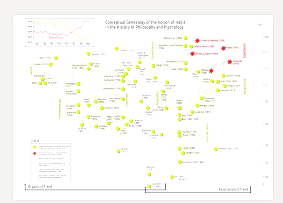
A genealogical map of the concept of habit

Genealogical map for the concept of habitTogether with Ezequiel Di Paolo, we have just published a paper that is the result of a long lasting research (it is more than 6 years now since we started this project!) of doing a history of the notion of habit, to rescue it as a theoretical primitive for cognitive (neuro)science. The paper is entitled «A genealogical map of the concept of habit«, published at Frontiersin, within a special issue on habit. The work is presented as a mini-review focusing on a genealogical map of the historical trends and influences of the habit concept from Greece to 1980s. Different versions of the map of the genealogy of the concept of habit are available to donwload for future development.

ABSTRACT: The notion of information processing has dominated the study of the mind for over six decades. However, before the advent of cognitivism, one of the most prominent theoretical ideas was that of Habit. This is a concept with a rich and complex history, which is again starting to awaken interest, following recent embodied, enactive critiques of computationalist frameworks. We offer here a very brief history of the concept of habit in the form of a genealogical network-map. This serves to provide an overview of the richness of this notion and as a guide for further re-appraisal. We identify 77 thinkers and their influences, and group them into seven schools of thought. Two major trends can be distinguished. One is the associationist trend, starting with the work of Locke and Hume, developed by Hartley, Bain, and Mill to be later absorbed into behaviorism through pioneering animal psychologists (Morgan and Thorndike). This tradition conceived of habits atomistically and as automatisms (a conception later debunked by cognitivism). Another historical trend we have called organicism inherits the legacy of Aristotle and develops along German idealism, French spiritualism, pragmatism, and phenomenology. It feeds into the work of continental psychologists in the early 20th century, influencing important figures such as Merleau-Ponty, Piaget, and Gibson. But it has not yet been taken up by mainstream cognitive neuroscience and psychology. Habits, in this tradition, are seen as ecological, self-organizing structures that relate to a web of predispositions and plastic dependencies both in the agent and in the environment. In addition, they are not conceptualized in opposition to rational, volitional processes, but as transversing a continuum from reflective to embodied intentionality. These are properties that make habit a particularly attractive idea for embodied, enactive perspectives, which can now re-evaluate it in light of dynamical systems theory and complexity research.

Systematicity of thought and systemicity of habits

I just got back from the workshop «Systematicity and the post-connectionist era«, where I presented a talk entitled «From systematicity of thought to systemicity of habits«. Congratulations to the organizers for this extraordinary experience.

My talk started by assuming the real challenge of systematicity for dynamical approaches. The work of René Thom and Jean Petitot on morphodynamics and cognitive grammars serves as a powerful framework to solve this problem. In the second part of the talk I defend a contemporary re-appraisal of the notion of habit within the Piagetian framework, with illustrations from evolutionary robotics. You can download the pdf of the slides bellow:

Phylogeny of the notion of Habit

Together with Ezequiel Di Paolo we embarked into a historical research on the notion of Habits as theoretical building blocks for cognitive science. Far from the simplified stimulus-response pairing conception of habits defended by behaviorism, we found that habits have long been a very rich conceptual category at the root of the sciences and philosophies of mind, until very recently. Here is a preliminary graph that summarizes some of our results (that would hopefully be published as a paper some time soon):

Phylogeny of the concept of Habit. The graph is still under development but captures the most important trends.

Seguir leyendo «Phylogeny of the notion of Habit»

COGS Talk: Defining Agency

I gave a COGS Seminar Series talk here at Sussex. The title was «Defining Agency» where I presented the paper with the same title that I wrote together with Ezequiel Di Paolo and Marieke Rohde. I also included an example of the paper presented at ECAL2009 with Matthew Egbert. Thanks to Nicholas Hockins, there is a video of the talk available in Archive:

The video and the presentation slides can be downloaded from Archive or you can directly click on the picture above to download it (I am waiting for Archive to convert it into an online flash player).