Generative Midtentionality: How AI could change intentionality

Barandiaran, X. E., & Pérez-Verdugo, M. (2025). Generative midtended cognition and Artificial Intelligence: Thinging with thinging things. Synthese, 205(4), 1–24. https://doi.org/10.1007/s11229-025-04961-4

Previous preprint available:

I really do think with my pen, because my head
often knows nothing about what my hand is writing

WITTGENSTEIN

I’m excited to share a recent publication co-authored with Marta Pérez-Verdugo titled Generative Midtended Cognition and Artificial Intelligence: Thinging with Thinging Things. This paper represents an initial step in our broader exploration of how generative AI transforms human cognitive agency in ways that traditional frameworks of extended cognition fall short of capturing.

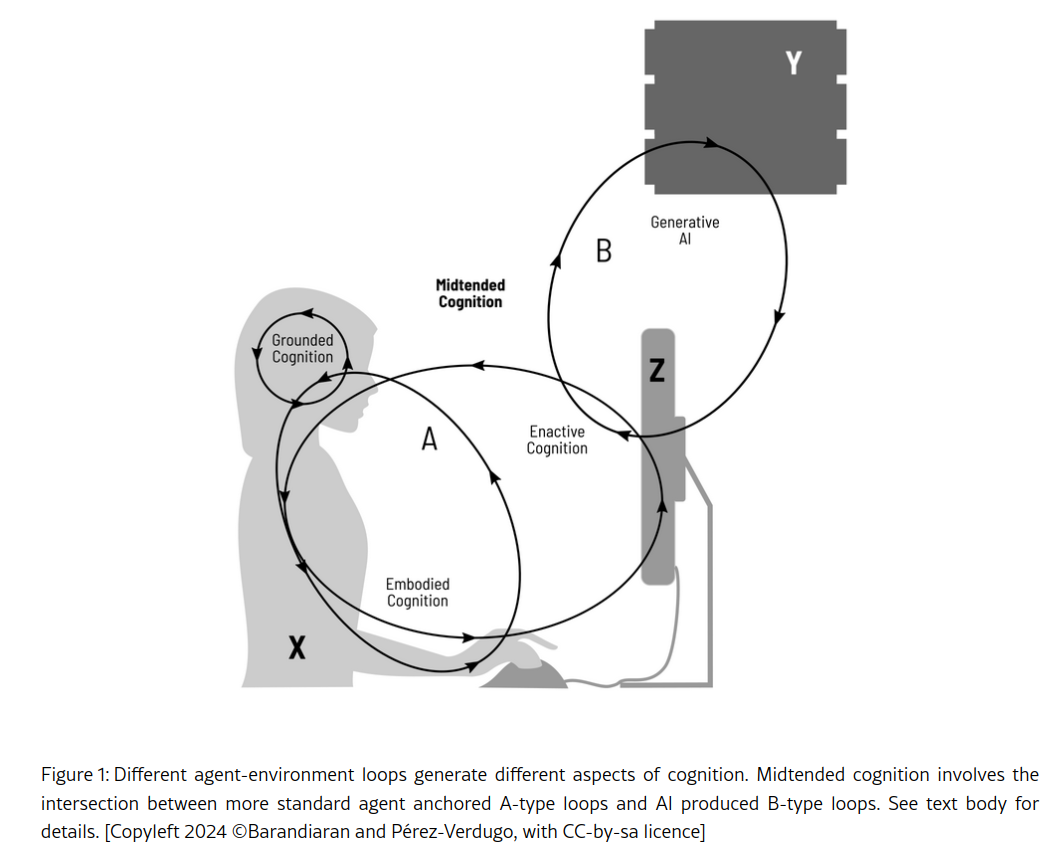
Did you ever experience the situation in which a human provided you with the word you were struggling to find out, accepted the suggestion, made it your own, and kept talking? Well, it happens that generative AI technologies are expanding this phenomenon to unprecedented levels. In this paper we start thinking about the consequences. To do so our work introduces the novel concept of «generative midtended cognition.» This term describes a hybrid cognitive process where generative AI becomes part of human creative agency, enabling interactions that sit between intention and extension: thus midtention. With AI’s ability to iteratively generate complex outputs, «midtended» cognition reflects the creative process where humans and AI co-generate a product, shaping the outcome together (see figure below). We explicitly define midtended cognition as follows:

Given a cognitive agent X, a generative system Y (artificial or otherwise) and cognitive product Z, midtension takes place when generative interventions produced by Y become constitutive of the intentional generation of Z by X, whereby X keeps some sense of agency or authorship over Z.
For those interested in cognitive science, philosophy of mind, or the implications of generative AI, this paper offers a theoretical basis to understand the cognitive depth of these human-AI interactions. Beyond classical extended, enactive and material cognition approaches, we suggest that generative AI initiates a form of cognition closer to social interactions than classical extended cognition approaches to technology. Yet, interacting with a generative AI is not itself a social interaction stricto sensu. It is something new. In order to get a better grasp on this novelty, we introduce and analyse two dimensions of “width” (sensitivity to context) and “depth” (granularity of interaction).

Given the unique generative power of these technologies and the hybrid forms of human-environment interactions they make possible, it’s essential to address both the promising potential and the ethical challenges they introduce. The paper explores multiple scenarios, from authenticity risks to the spectre of cognitive atrophy. But perhaps, it points out to a new concept we find particularly revealing and worth a follow-up paper to develop in depth: that of the economy of intention. We have previously analysed the concept of the economy of attention, an economic driver of contemporary social order and disorders. The phenomenon of Midtended Cognition might well move cognitive capitalism a step forward into a deeper commodification of the mind: not only the information that captures our attention, but the very intentional plans, creations, and projects we make «our own» might now be vulnerable to corporate injection.

ABSTRACT: This paper introduces the concept of  “generative midtended cognition”, that explores the integration of generative AI technologies with human cognitive processes. The term «generative» reflects AI’s ability to iteratively produce structured outputs, while «midtended» captures the potential hybrid (human-AI) nature of the process. It stands between traditional conceptions of intended creation, understood as steered or directed from within, and extended processes that bring exo-biological processes into the creative process. We examine the working of current generative technologies (based on multimodal transformer architectures typical of large language models like ChatGPT), to explain how they can transform human cognitive agency beyond what the conceptual resources of standard theories of extended cognition can capture. We suggest that the type of cognitive activity typical of the coupling between a human and generative technologies is closer (but not equivalent) to social cognition than to classical extended cognitive paradigms. Yet, it deserves a specific treatment. We provide an explicit definition of generative midtended cognition in which we treat interventions by AI systems as constitutive of the agent’s intentional creative processes. Furthermore, we distinguish two dimensions of generative hybrid creativity: 1. Width: captures the sensitivity of the context of the generative process (from the single letter to the whole historical and surrounding data), 2. Depth: captures the granularity of iteration loops involved in the process. Generative midtended cognition stands in the middle depth between conversational forms of cognition in which complete utterances or creative units are exchanged, and micro-cognitive (e.g. neural) subpersonal processes. Finally, the paper discusses the potential risks and benefits of widespread generative AI adoption, including the challenges of authenticity, generative power asymmetry, and creative boost or atrophy.

Against Fatalism: why thermodynamics doesn’t pull us to collapse.

I am pleased to share with you a recent publication co-authored with Alex Merlo. The paper is an important first step in Alex’s PhD thesis of exploring the politics of the earth system from the point of view of philosophy of science. The paper touches upon classical topics of autonomous and enactive approaches to life and mind, but at a scale that has rarely been the focus of our analysis: thermodynamics at the planetary scale. For those of you interested in climate change, thermodynamics and life, or, from a philosophy of science perspective, on «extremum principles» (maximum entropy, etc.), I think the paper has a lot to offer. It also has important political implications. We have been motivated to debunk fatalism, which is almost a kind of zeitgeist among many today. Reactionary postmodern authors like Nick Land, who rest the collective mind on the accelerator of turbocapitalism, are among our covert targets. But generally, the paper builds systematic arguments against all those approaches that leave human and biological agency at the corner of maximimization principles (with alleged thermodynamic foundations): «there is nothing we can do to stop our fate but to accelerate or decelerate the inevitable increase of entropy». It turns out, we argue, that what characterizes life on earth (that it, the only life we know) is its capacity to organize thermodynamic gradients to increase the diversity and frugality of life. It is time we also start to do so.

  • Merlo, A., & Barandiaran, X. E. (2024). Beyond fatalism: Gaia, entropy, and the autonomy of anthropogenic life on Earth. Ethics in Science and Environmental Politics, 24, 61–75. https://doi.org/10.3354/esep00213

ABSTRACT: The current disruption of ecosystems and climate systems can be likened to an increase in entropy within our planet. This concept is often linked to the second law of thermodynamics, which predicts a necessary rise in entropy resulting from all material and energy-related processes, including the intricate organisation of living systems. Consequently, discussions surrounding the ongoing crisis commonly carry an underlying sense of fatalism when referencing thermodynamic principles. In this study, we explore how the understanding of life has been harmonized with thermodynamics to show that entropy production is a consequence of heightened complexity in life rather than its breakdown. Furthermore, it is crucial to perform a thermodynamic analysis of the Earth system as a whole to dispel fatalistic assumptions. The extremum principles linked to thermodynamics do not foretell the precise evolution of complex organisations but rather set the thermodynamic boundaries associated with their development. Ultimately, treating the Earth system as an integrated autonomous entity in which life and human societies play pivotal roles is essential for charting a sustainable path forward for humanity. Understanding how to contribute to thermodynamic states that are more conducive to life, rather than hastening the journey towards disordered states, is paramount for human survival and well-being in the Anthropocene era.

Personal Autonomy and (Digital) Technology: An Enactive Sensorimotor Framework

I am glad to share this new publication in collaboration with Marta Pérez-Verdugo (first author and main contributor to this paper). This is my first (probably the first?) serious and deep philosophical application of sensorimotor life theories of cognition to digital, and more generally technological, environments. It also brings with it ethical and political implications in the way in which digital environments constraint technopolitical autonomy, and makes a notable contribution to the connection between autonomy in moral philosophy and autonomy in enactive theorizing (thanks to the great work made by Marta). The paper is also very programmatic and foundational, for it characterizes technology and technical behaviour in enactive terms and opens the way to further developments to come. Finally, the paper illuminates the way in which we get so often captured or steered by interface design in digital platforms and how to build autonomy-enhancing digital environments.

Pérez-Verdugo, M., & Barandiaran, X. E. (2023). Personal Autonomy and (Digital) Technology: An Enactive Sensorimotor Framework. Philosophy & Technology, 36(4), 84. https://doi.org/10.1007/s13347-023-00683-y.

ABSTRACT: Many digital technologies, designed and controlled by intensive data-driven corporate platforms, have become ubiquitous for many of our daily activities. This has raised political and ethical concerns over how they might be threatening our personal autonomy. However, not much philosophical attention has been paid to the specific role that their hyper-designed (sensorimotor) interfaces play in this regard. In this paper, we aim to offer a novel framework that can ground personal autonomy on sensorimotor interaction and, from there, directly address how technological design affects personal autonomy. To do this, we will draw from enactive sensorimotor approaches to cognition, focusing on the central notion of habits, understood as sensorimotor schemes that, in networked relations, give rise to sensorimotor agency. Starting from sensorimotor agency as a basis for more complex forms of personal autonomy, our approach gives us grounds to analyse our relationship with technology (in general) and to distinguish between autonomy-enhancing and autonomy-diminishing technologies. We argue that, by favouring/obstructing the enactment of certain (networks of) habits over others, technologies can directly act upon our personal autonomy, locally and globally. With this in mind, we then discuss how current digital technologies are often being designed to be autonomy-diminishing (as is the case of “dark patterns” in design), and sketch some ideas on how to build more autonomy-enhancing digital technologies.

Sensorimotor Life. An Enactive Proposal (the Book)

Cover image of Sensorimotor Life

It has been some time now since we published this book. At the time I was too busy working at Barcelona City Council and could not publish a post on this blog. It is now time to do so.

Chapters 5 and 6 of the book are based on my PhD thesis and I am proud to see it published within the more ellaborate framework of this book.

From the official summary of the book: «Sensorimotor Life draws on current theoretical developments in the enactive approach to life and mind. It examines and expands the premises of the sciences of the human mind, while developing an alternative picture closer to people’s daily experiences. Enactive ideas are applied and extended, providing a theoretically rich, naturalistic account of meaning and agency. The book includes a dynamical systems description of different types of sensorimotor regularities or sensorimotor contingencies; a dynamical interpretation of Piaget’s theory of equilibration to ground the concept of sensorimotor mastery; and a theory of agency as organized networks of sensorimotor schemes, as well as its implications for embodied subjectivity.»

The book is available online in various formats. You can download a PDF version of «Sensorimotor Life. An Enactive Proposal» here.

Seguir leyendo «Sensorimotor Life. An Enactive Proposal (the Book)»

A minimal model of metabolism-based chemotaxis

Egbert, M. D., Barandiaran, X. E., & Di Paolo, E. A. (2010). A Minimal Model of Metabolism-Based Chemotaxis. PLoS Comput Biol, 6(12), e1001004.

We present the first model of metabolism-based chemotaxis that accomplishes chemotaxis without transmembrane receptors or signal transduction proteins, through the direct modulation of flagellar rotation by metabolite concentrations. The minimal model recreates chemotactic patterns found in real bacteria, illuminating some previous work metabolism-dependent chemotaxis. A nice example of the inpiration taken from an autonomous perspective on agency, linking metabolism and behaviour.

Seguir leyendo «A minimal model of metabolism-based chemotaxis»

Behavioral Metabolution: the very idea

The paper I wrote together with Matthew Egbert and Ezequiel Di Paolo got accepted and will be soon published at the Proceedings of the 12th International Conference on Artificial Life. It is entitled Behavioral Metabolution: Metabolism Based Behavior Enables New Forms of Adaptation and Evolution and it addresses, the evolutionary scale interaction between metabolism and behavior, using a simulation of a bacteria-like moving protocell whose behavioral architecture is constituted by metabolism itself.

Behavioral Metabolution Paper Thumbnail

Seguir leyendo «Behavioral Metabolution: the very idea»

Homeostatic Plasticity in Robots

I am presenting this poster at the CogSys2010 Conference in Zurich. The poster shows some results of a simulation model I developed long ago (almost 5 years ago!) on a reinforcement learning task with evolutionary robotics, using homeostatic plasticity on the CTRNN controllers. I am currently writing a paper with Ezequiel Di Paolo on the details of the simulation model. The agents are capable to display a developmental process (connection weights are initialized at value 0), to solve an operant conditioning task and display the spontaneous formation of habits.

Seguir leyendo «Homeostatic Plasticity in Robots»

Chemo-ethology of an adaptive protocell

I joined Matthew Egbert and Ezequiel di Paolo on this paper exploring the emergence of viability boundaries on a simulated protocell and quantifying its behavioural adaptivity in relation to such boundaries. The paper addresses some key issues regarding the origins of norms and adaptive behaviour. It got published on the Tenth European Conference on Artificial Life, ECAL09, Budapest, September 13-16, 2009, Springer Verlag.


Seguir leyendo «Chemo-ethology of an adaptive protocell»

Animats in the Modelling Ecosystems (Response to Barbara Webb)

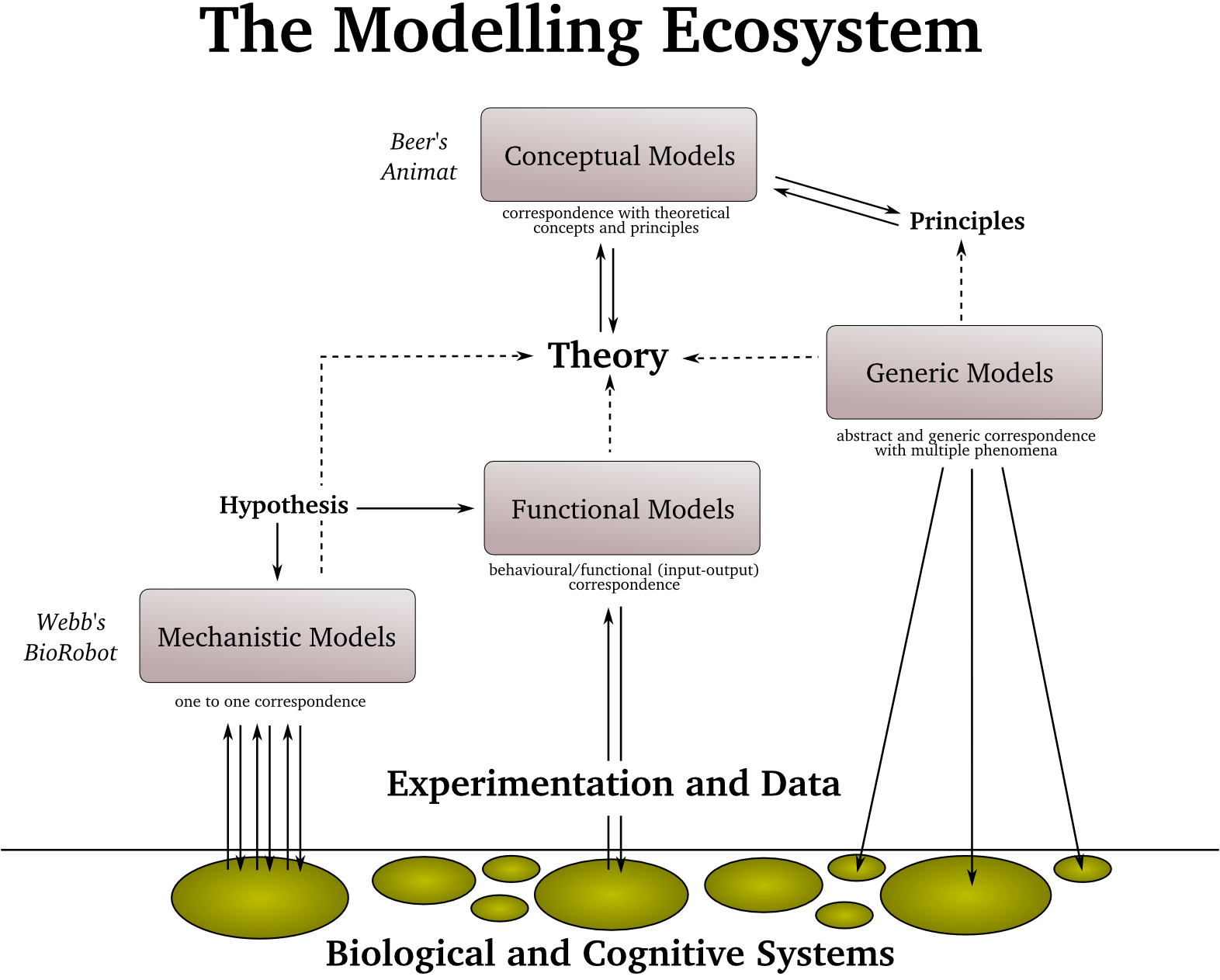
The Journal of Adaptive Behavior has recently published a target article by Barbara Webb entitled «Animats vs. Animals». I was invited to write a critical response to her paper and joined Anthony Chemero to defend a variety of models in science, ranging from the most concrete to the most abstract.

types_of_models

Seguir leyendo «Animats in the Modelling Ecosystems (Response to Barbara Webb)»

Defining Agency

I have just recently submitted the last version for publication of a new paper, together with Ezequiel Di Paolo and Marieke Rohde: Defining Agency. Individuality, Normativity, Asymmetry and Spatio-temporality in Action, to be published soon on a special issue on Agency edited by Mareke Rohde and Takashi Ikegami on Adaptive Behavior journal.

defining_agency_screenshot

Seguir leyendo «Defining Agency»