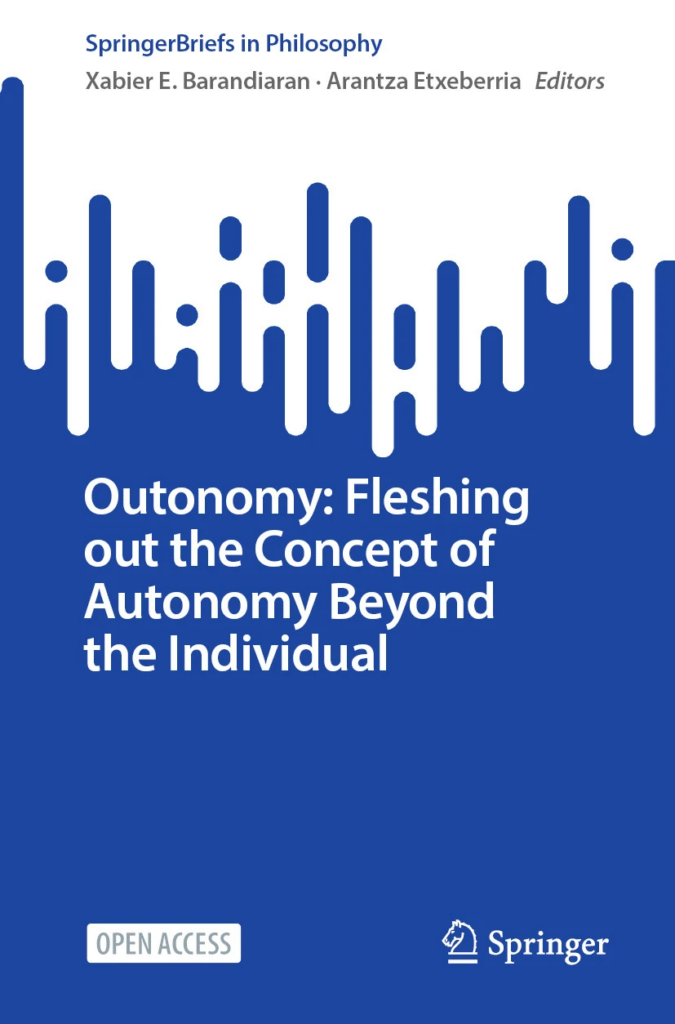
I am very happy to announce the publication of Outonomy: Fleshing out the Concept of Autonomy Beyond the Individual, edited by Arantza Etxeberria and me. This book is the unified and integrated result of our the research project of the same title lead by myself and Leonardo Bich that finished over a year ago. The book gathers a rich, cross-disciplinary exploration of autonomy that moves beyond the classic, self-sufficient, abstract, rational and detached model of the individual we inherited from modernity. Instead, it develops the concept of outonomy to capture how autonomy is constituted through relations: with environments, other agents, technologies, institutions, and social-ecological systems.
Why “Outonomy”?
Autonomy has long been central to modern thought, ethics, and the life sciences. But many contemporary debates across philosophy of biology, cognitive science, medicine, technology studies, and political theory show that the boundaries and concerns of the individual more far beyond itself. The outonomy framework responds to this situation by offering a more interactional and environmentally situated account of self-governance and normativity.
In the opening chapter, Barandiaran and Etxeberria outline 4 key properties that help articulate this shift:
Interactivity
Collectivity
Extensionality
Environmentality
Along two fundamental dimensions:
Integration
Sustainability
Together, these ideas reframe autonomy as something that emerges across scales of interaction and dependence, rather than something sealed within an isolated individual.
A structured journey across life, mind, technology, and politics
The volume is organized into four parts that build a coherent arc while engaging multiple domains:
Part I: Theoretical Insights Foundational chapters clarify the conceptual stakes of outonomy and rethink control and organization in biological systems.
Part II: The Fabric of Life Chapters address environments and asymmetries, the origins of life, reproduction, and a compelling application to menstrual health.
Part III: The Psychic Self and Its Environment Here the outonomy perspective extends into psychiatry, salutogenesis, and pain, emphasizing embodied and relational normativity.
Part IV: Technology, Ecology & Politics These chapters explore technocomplexity, the limits of autonomy in social-ecological systems, subjects-in-common, and mindshaping in relation to adaptive preferences.
Co-authored chapters
I have co-edited the book, and co-authores three chapters:
Barandiaran, X. E., & Etxeberria, A. (2026). Outonomy, the Very Idea. In X. E. Barandiaran & A. Etxeberria (Eds.), Outonomy: Fleshing out the Concept of Autonomy Beyond the Individual (pp. 3–12). Springer Nature Switzerland. https://doi.org/10.1007/978-3-032-05501-9_1
Here we introduce the concept of Outonomy as an attempt to overcome some of the limitations of the concept of autonomy as inherited from modernity.
Cabello, V., Merlo, A., Mancilla, M., Siqueiros, J. M., & Barandiaran, X. E. (2026). Autonomy and Its Limits in Social-Ecological Systems. In X. E. Barandiaran & A. Etxeberria (Eds.), Outonomy: Fleshing out the Concept of Autonomy Beyond the Individual (pp. 121–130). Springer Nature Switzerland. https://doi.org/10.1007/978-3-032-05501-9_12
In this chapter, we approach the notion of autonomy at its largest planetary scale. Social-ecological systems are in need of a deep exercise of autonomy as self-limitation and care if we are to avoid the increasing destruction of living diversity and flourishing life on earth.
Calleja-López, A., Pérez-Verdugo, M., & Barandiaran, X. E. (2026). Autonomy and Technology: From Instrumentalism to Technocomplexity. In X. E. Barandiaran & A. Etxeberria (Eds.), Outonomy: Fleshing out the Concept of Autonomy Beyond the Individual (pp. 111–120). Springer Nature Switzerland. https://doi.org/10.1007/978-3-032-05501-9_11
This chapter captures the dialectical moments that tie autonomy and technology, from the naïve, yet widespread, instrumental use to the techno-complex participatory constitution of our extended life, passing through the persistent thread of an increasingly autonomous techno-economic system that subsumes and alienates human autonomy.
A collaborative research effort
The book emerges from sustained work within the Outonomy research network and related projects, with authors actively reviewing and strengthening each other’s contributions. It also benefits from external reviewers who helped refine the final manuscript.
Why does a heart attack count as a malfunction, but a volcanic eruption doesn’t? What makes one failure meaningful while the other is merely an outcome of physical laws? This is a foundational question in philosophy. It conditions the nature of explanations in philosophy of science, the autonomy of biology, the concepts of adaptiveness, health or well-being, the possibility of meaning emerging in nature, or, ultimately, our own judgement.
At the most basic level, at the heart of biological explanation, lies the idea of function. Your heart functions to pump blood; your kidneys function to filter it. But the idea of function implies something deeper: that things can go wrong. If a function can succeed, it can also fail.
“There is no function if there is no room for failure or possibility of malfunctioning, otherwise the notion of function would add nothing to the mere description of a process,” (p. 2)
There are different accounts of (mal)function in the philosophical pool. Most classical theories of function fall into two camps: biostatistical and etiological. The first (Boorse) defines dysfunction as statistical deviance from the norm. The second (Millikan, Neander) grounds function in evolutionary history—traits fail if they don’t do what they were selected to do. An alternative to these accounts is the so-called organizational account. It states that a trait malfunctions when it fails to contribute to the self-maintenance of the system it belongs to, in the manner that other parts dynamically (functionally) presupposes it to do so. I have been discontinuously working on this theory since my MSc thesis (2002), then with Alvaro Moreno (2008), then with Ezequiel Di Paolo and Marieke Rohde (2009), and lastly with Mattew Egbert (2014).
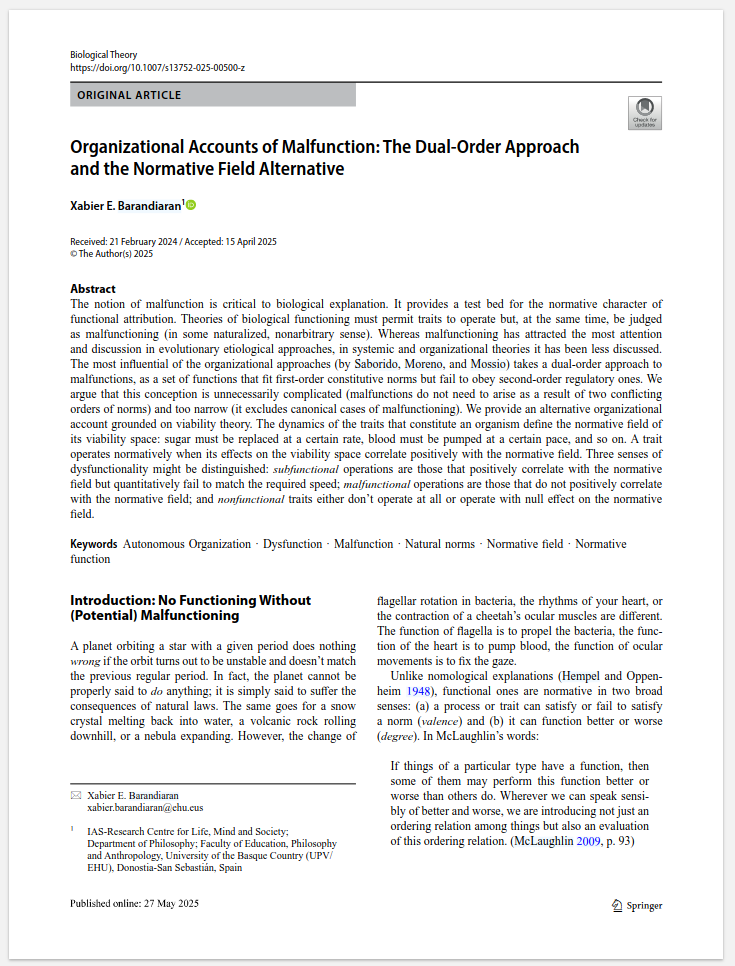
The canonical definition of the organization approach to function is due to Mossio, Saborido and Moreno, to be latter reframed in Moreno and Mossio’s book “Biological Autonomy” in 2015. This paper is somehow a (very) late response to some problems inherent on their specific understanding of malfunction. I have named it the “dual-order” approach because it defines malfunction as a failure of a trait to respond to a regulatory command to switch between “regimes” of self-maintenance. I suggest we need to take a different route (advanced and formalized in Barandiaran and Egbert 2014). My alternative does away with the need for two orders of norms, and proposes a gradual (non-binnary) account of function. It analyses malfunction dynamically, in terms of how a trait’s activity aligns with what is minimally required for maintaining viability. I use the concept of a “normative field”—a gradient that specifies, at each point, how a variable (like heart rate or food intake) needs to change to avoid system collapse.
“A trait operates normatively when its effects on the viability space correlate positively with the normative field”. (p. 8)
With this approach, it is possible to distinguish between different types of dysfunction (see figure panel d):
Subfunction: the trait works, but too slowly or insufficiently.
Malfunction: the trait works against what’s required.
Nonfunction: the trait fails to operate at all when needed.
Fig. 2 Bifurcation diagram of a system, depicting the incoming food concentration [F] on the x-axis and the amount of internal metabolite concentration [A] on the y-axis. Subfigure a depicts the tendency of the system to two stable equilibria (solid lines), the death state at [A] = 0 and the viable state (top curved line), an unstable equilibrium is depicted with a dashed line. Tendencies of [A] are depicted with vertical arrows, with a constant supply of [F] the system at point r moves to the stable living or viable equilibrium, while departing from s it evolves to [A] = 0 and dies. Subfigure b displays a partition of the state space into Viable, Precious and Terminal regions derived from the tendencies of [A]. Subfigure c depicts the normative field as the positive change of [F] that is necessary at each point of the precarious region to avoid death. Subfigure d represents 4 different types of trajectories within the viability space: functioning or functional increase of [F] positively correlated with the normative field, malfunctioning modulation of [F] that is not correlated with the normative field and will eventually lead to death, non-functioning trajectories also lead to death by inactivity and subfunctioning trajectories are positively correlated with the normative field (pushing [F] to increase) but fail to save the life of the organism (see text for more details).
This classification captures biological nuance that the dual-order model cannot, such as partial failures within a single regime or regulatory dysfunctions at higher systemic levels.
What I offer is a more parsimonious, gradated, and inclusive framework. Rather than splitting the world into constitutive and regulatory norms, my approach captures both under a unified formalism. Biological systems, after all, are full of gradual regulation, not binary switches. Hormones, enzyme levels, and neuronal excitations rarely flip like light switches—they modulate, fine-tune, oscillate. In short, I argue, the Normative Field Approach provides a robust and flexible model for understanding malfunction.
I conclude with a short metaphysical exhort on the nature of functions that I feel tempted to turn into a full paper: “From an operational perspective, norms appear as conditions of possibility for the organism’s very existence—within an extended present (or across scales of extended presents) that sustain the organization anchoring those norms. This does not exactly render norms epiphenomenal; rather, it suggests an explanation that cuts across both epi- and sub-phenomenal levels. Normativity could be said to be epiphenomenal in the sense that it offers a higher-order normative description of system operations—descriptions that different parts of the system may or may not conform to, to varying degrees. At the same time, it is sub-phenomenal (and thus transcendental in the Kantian sense) insofar as it refers to modes of functioning among parts that constitute the very conditions of possibility for the system’s ongoing existence. For the system to exist as an observable entity here and now, the normative description must already have been satisfied.” (p. 16)
«it suggests an explanation that cuts across both epi- and sub-phenomenal levels.» (p.16)
This way of conceiving (mal)functions has consequences. Particularly if we are to avoid normalizing instrumentations of functionality and dysfunctionality (e.g. by claiming that somebody’s behaviour is dysfuctional because it deviates from statistical normality or from historical competitive selection) and favours instead a system centered, environmentally sensitive, open and singular account of function anchored on the autonomy of the system under care:
“[I]t is ultimately the autonomy of each living organization (in its open and interdependent singularity and becoming) that marks the horizon of normative judgements.” (p.16)
ABSTRACT: The notion of malfunction is critical to biological explanation. It provides a test bed for the normative character of functional attribution. Theories of biological functioning must permit traits to operate but, at the same time, be judged as malfunctioning (in some naturalized, nonarbitrary sense). Whereas malfunctioning has attracted the most attention and discussion in evolutionary etiological approaches, in systemic and organizational theories it has been less discussed. The most influential of the organizational approaches (by Saborido, Moreno, and Mossio) takes a dual-order approach to malfunctions, as a set of functions that fit first-order constitutive norms but fail to obey second-order regulatory ones. We argue that this conception is unnecessarily complicated (malfunctions do not need to arise as a result of two conflicting orders of norms) and too narrow (it excludes canonical cases of malfunctioning). We provide an alternative organizational account grounded on viability theory. The dynamics of the traits that constitute an organism define the normative field of its viability space: sugar must be replaced at a certain rate, blood must be pumped at a certain pace, and so on. A trait operates normatively when its effects on the viability space correlate positively with the normative field. Three senses of dysfunctionality might be distinguished: subfunctional operations are those that positively correlate with the normative field but quantitatively fail to match the required speed; malfunctional operations are those that do not positively correlate with the normative field; and nonfunctional traits either don’t operate at all or operate with null effect on the normative field.
I have been working with Lola Almendros for almost two years on this paper. It has taken looong to finish. But it is now available as a preprint. Here is a quote of one of the central ideas:
ChatGPT operates as a gigantic (…) library-that-talks, enabling a dialogical engagement with the vast corpus of human knowledge and cultural heritage it has ‘internalized’ (compressed on its transformer multidimensional spaces) and that it is capable of recruiting effectively in linguistic exchange. The machine’s interlocution, though devoid of personal intentionality, bears the trace of human experience as transposed into digitalized textuality. The purpose-structured and bounded automatic interlocution, however, can be experienced as a genuine dialogue by the human subject.
Generative technologies, and more specifically, Large Language Models (like ChatGPT, Gemini, Mixtral, Llama, or Claude) are rapidly expanding and populating our everyday toolbox and interaction space. If philosophy is understood as the practice of crafting (new) concepts to (better) organize our life… we have some job to do! Many conceptualize LLMs as mere “dumb statistical engines”, others as “sentient persons” … But what are they exactly? We know they are capable of surpassing existing intelligence benchmarks while, at the same time, failing to solve some kinds of simple puzzles.
Inspired on Simondon’s insights that part of our alienation regarding technology has to do with our lack of understanding of what technical object are and how they work, this paper deepens into the architecture, processing and systemic couplings under which LLMs (like ChatGPT) operate. We contrast this operational structure with those of living agents to conclude that LLMs fail to meet the requirements that characterized them. If not as agents, then… how to categorize LLMs? Here is one proposal:
[M]ore than a self-bootstrapped Artificial Intelligence, ChatGPT, as an interlocutor automaton, is a computational proxy of the human collective intelligence externalized into a digitalized written body. It is, in turn, shaped and taken care of by hundreds of human and non-human lives. […] This happens not just at a contextual level or as an operational environment, but at a constitutive level. No LLM is an island. And their performative power, and derived agentive capacities (if any), inherently rest on human and planetary scale life.
Moreover:
LLMs display capacities that effectively mobilize human intelligence as embodied in massive textuality, affectively mobilize human intelligence in conversation, and can activate forms of hybrid agency previously unavailable for human intelligence.
And yet, the scale of LLM operations is immense and beyond explainable human capacity to fully conceptualized. For example, GPT-3 was trained on 570 GB of text data, equivalent to around 2 million books, which would take a human over 500 years to read. Moreover, processing tasks performed by LLMs involve computational operations on a scale that would take a human expert millions of years to replicate if carried out step-by-step. We conclude:
By a digitality that deep, it is reasonable to hold that the boundary between invention and discovery, between artifact and nature, between engineering and science is somewhat blurred. We have built LLMs as much as we have discovered their emergent capabilities.
This paper is a preliminary (ontological) analysis of LLMs and transformer technologies and their coupling with human agency. Our goal is to address the deep technopolitical challenges and opportunities that this type of devices (and their social-ecological support networks) have opened.
ABSTRACT: This paper investigates the ontological characterization of Large Language Models (LLMs) like ChatGPT. Between inflationary and deflationary accounts, we pay special attention to their status as agents. This requires explaining in detail the architecture, processing, and training procedures that enable LLMs to display their capacities, and the extensions used to turn LLMs into agent-like systems. After a systematic analysis we conclude that a LLM fails to meet necessary and sufficient conditions for autonomous agency in the light of embodied theories of mind: the individuality condition (it is not the product of its own activity, it is not even directly affected by it), the normativity condition (it does not generate its own norms or goals), and, partially the interactional asymmetry condition (it is not the origin and sustained source of its interaction with the environment). If not agents, then … what are LLMs? We argue that ChatGPT should be characterized as an interlocutor or linguistic automaton, a library-that-talks, devoid of (autonomous) agency, but capable to engage performatively on non-purposeful yet purpose-structured and purpose-bounded tasks. When interacting with humans, a «ghostly» component of the human-machine interaction makes it possible to enact genuine conversational experiences with LLMs. Despite their lack of sensorimotor and biological embodiment, LLMs textual embodiment (the training corpus) and resource-hungry computational embodiment, significantly transform existing forms of human agency. Beyond assisted and extended agency, the LLM-human coupling can produce midtended forms of agency, closer to the production of intentional agency than to the extended instrumentality of any previous technologies.
I am pleased to share with you a recent publication co-authored with Alex Merlo. The paper is an important first step in Alex’s PhD thesis of exploring the politics of the earth system from the point of view of philosophy of science. The paper touches upon classical topics of autonomous and enactive approaches to life and mind, but at a scale that has rarely been the focus of our analysis: thermodynamics at the planetary scale. For those of you interested in climate change, thermodynamics and life, or, from a philosophy of science perspective, on «extremum principles» (maximum entropy, etc.), I think the paper has a lot to offer. It also has important political implications. We have been motivated to debunk fatalism, which is almost a kind of zeitgeist among many today. Reactionary postmodern authors like Nick Land, who rest the collective mind on the accelerator of turbocapitalism, are among our covert targets. But generally, the paper builds systematic arguments against all those approaches that leave human and biological agency at the corner of maximimization principles (with alleged thermodynamic foundations): «there is nothing we can do to stop our fate but to accelerate or decelerate the inevitable increase of entropy». It turns out, we argue, that what characterizes life on earth (that it, the only life we know) is its capacity to organize thermodynamic gradients to increase the diversity and frugality of life. It is time we also start to do so.
Merlo, A., & Barandiaran, X. E. (2024). Beyond fatalism: Gaia, entropy, and the autonomy of anthropogenic life on Earth. Ethics in Science and Environmental Politics, 24, 61–75. https://doi.org/10.3354/esep00213
ABSTRACT: The current disruption of ecosystems and climate systems can be likened to an increase in entropy within our planet. This concept is often linked to the second law of thermodynamics, which predicts a necessary rise in entropy resulting from all material and energy-related processes, including the intricate organisation of living systems. Consequently, discussions surrounding the ongoing crisis commonly carry an underlying sense of fatalism when referencing thermodynamic principles. In this study, we explore how the understanding of life has been harmonized with thermodynamics to show that entropy production is a consequence of heightened complexity in life rather than its breakdown. Furthermore, it is crucial to perform a thermodynamic analysis of the Earth system as a whole to dispel fatalistic assumptions. The extremum principles linked to thermodynamics do not foretell the precise evolution of complex organisations but rather set the thermodynamic boundaries associated with their development. Ultimately, treating the Earth system as an integrated autonomous entity in which life and human societies play pivotal roles is essential for charting a sustainable path forward for humanity. Understanding how to contribute to thermodynamic states that are more conducive to life, rather than hastening the journey towards disordered states, is paramount for human survival and well-being in the Anthropocene era.
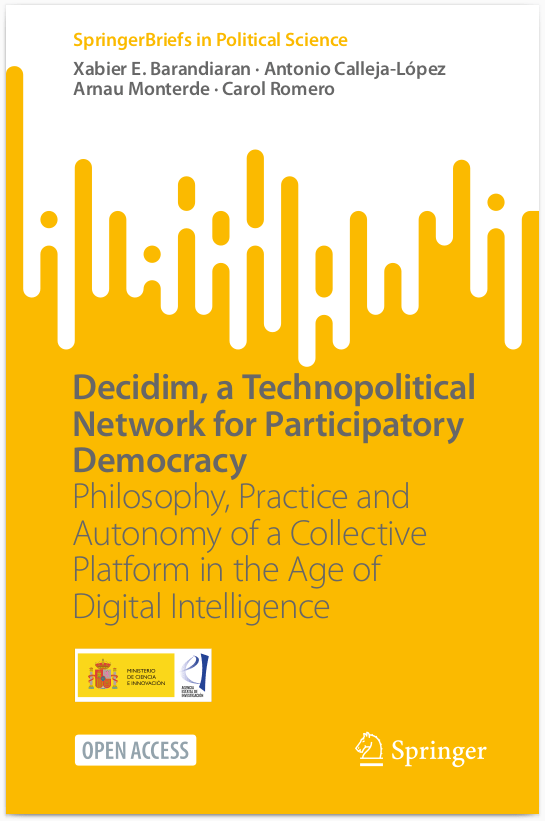
It has taken almost 6 years since we started writing what, at the time, we called Decidim’s White Paper. Some drafts of the early book have been circulating ever since, but we never completed the story. We were very busy doing Decidim. Years past, the project settled, and we took the time (thanks Antonio for offering us the great opportunity to push the book forward in Arantzazu!) to finally write it.
The table of contents of the book makes for a good summary:
Decidim: A Brief Overview
Here we summarize the nature of the project, its current impact, its history and why the project was born in the context of cognitive capitalism and the decline of neoliberal «democracies» on the one hand, and the dawn of digital commons and radical democracy on the other.
The Political Plane: Decidim and the Vision of a Radically Democratic Society
This part is the most theoretical, we review contemporary social and democratic theory to explain the type of democratic vision that Decidim is aimed to achieve.
The Technopolitical Plane: Decidim as a Democratic Software Paradigm
This chapter covers perhaps the most original aspect of the project, its careful technopolitical crafting, the way in which technical details are assembled to produce specific types of political effects and how the community embodies recursively those technical and political mechanism on its own constitution.
The Technical Plane: The Fabric of an Infrastructure
As the title anticipates, this is the most technical description of how the software, the community, the legal framework and the
A Technopolitical Network for Participatory Democracy: The Future of a Collective Platform
This is perhaps the most philosophical and speculative of all chapters. Recapitulating the content of the entire book, we project past, present and future challenges and provide a reading of what Decidim is and could be.
As an academic publication the book own much to the work of IAS-Research Group, and its decades of study of the autonomy of the living, now transposed to the autonomy of sociotechnical hybrids like this project: the democratic autonomous assemblage of the organic and the inorganic. The project Outonomy partially financed the publication with Open Access CreativeCommons By-SA licence.
I leave you with two quotes of the conclusions (chapter 5):
At the beginning of this book, we made clear that a project like Decidim might be necessary, but is certainly not sufficient for advancing democracy. There is no future for Decidim or for democracy without a deep transformation of the material living conditions, the social (and global) inequalities and the myriad of oppressive structures that are reproduced every day. Decidim should leave no room for techno-solutionism (the idea that social or political problems have technological solutions). It should equally debunk techno-fatalism. It already has. Decidim is an example of how it is possible to create and deploy a large-scale, radically transformative software project out of the platform capitalist model. An important challenge to any radical democratization process (particularly when addressing struggles) is the problem of coordination of collective action. This is where Decidim should be ready to become a valuable infrastructure, which may then contribute to address the challenges of complexity and conflictuality of society. (p. 124-5)
As a coagulation of hundreds of Metadecidim debates, the movement recursivity includes this very text; and so recrafts thinking, action, and, crucially, the frequently forgotten (re)production. We began suggesting that this book aims to think through Decidim after we did take part in it. Actually, we were thinking through Decidim as we were doing it, and Decidim keeps making and thinking itself today. With this book we came to recapitulate and throw out several lines of flight that show how Decidim has aimed to retie technology, politics, economics, ecology and beyond, and that flight has the form of a living animal: it is the flight of a cyborg owl. The cyborg owl can be taken as an imaginary ode to our animal and our technical, increasingly post-natural and allegedly post-humanist condition. Yet this owl is not the symbol of a Hegelian self-reflective movement that satisfies itself in contemplation, but the owl that flies in the evening to bring, back to the nest, the provision to sustain a new day. It is reflective action and active reflection aimed at producing and reproducing flourishing forms of life. (p.130-1)
I am glad to share this new publication in collaboration with Marta Pérez-Verdugo (first author and main contributor to this paper). This is my first (probably the first?) serious and deep philosophical application of sensorimotor life theories of cognition to digital, and more generally technological, environments. It also brings with it ethical and political implications in the way in which digital environments constraint technopolitical autonomy, and makes a notable contribution to the connection between autonomy in moral philosophy and autonomy in enactive theorizing (thanks to the great work made by Marta). The paper is also very programmatic and foundational, for it characterizes technology and technical behaviour in enactive terms and opens the way to further developments to come. Finally, the paper illuminates the way in which we get so often captured or steered by interface design in digital platforms and how to build autonomy-enhancing digital environments.
ABSTRACT: Many digital technologies, designed and controlled by intensive data-driven corporate platforms, have become ubiquitous for many of our daily activities. This has raised political and ethical concerns over how they might be threatening our personal autonomy. However, not much philosophical attention has been paid to the specific role that their hyper-designed (sensorimotor) interfaces play in this regard. In this paper, we aim to offer a novel framework that can ground personal autonomy on sensorimotor interaction and, from there, directly address how technological design affects personal autonomy. To do this, we will draw from enactive sensorimotor approaches to cognition, focusing on the central notion of habits, understood as sensorimotor schemes that, in networked relations, give rise to sensorimotor agency. Starting from sensorimotor agency as a basis for more complex forms of personal autonomy, our approach gives us grounds to analyse our relationship with technology (in general) and to distinguish between autonomy-enhancing and autonomy-diminishing technologies. We argue that, by favouring/obstructing the enactment of certain (networks of) habits over others, technologies can directly act upon our personal autonomy, locally and globally. With this in mind, we then discuss how current digital technologies are often being designed to be autonomy-diminishing (as is the case of “dark patterns” in design), and sketch some ideas on how to build more autonomy-enhancing digital technologies.
Son ya muchos los años que llevo implicado en el proyecto Decidim, con notables altibajos, desde su fundación y diseño original hasta mi más reciente incorporación en el nuevo comité de coordinación. Durante todos estos años me ha tocado aprender, asesorar, guiar y disfrutar de muchos usos de Decidim. En este documento sistematizo algunos de los aprendizajes más importantes realizados durante estos años.
RESUMEN: Este documento es un manual para aquellas organizaciones y administraciones públicas (ayuntamientos, gobiernos autonómicos y estatales, ministerios, etc.) que quieran ofrecer un servicio digital para la participación pública usando Decidim. La sociedad contemporánea está irreversiblemente atravesada por una red de servicios digitales o plataformas que reconfiguran el campo social. Las instituciones públicas y organizaciones sociales no son ajenas a este cambio pero generalmente no disponen de medios digitales propios. Existen, sin embargo, alternativas como Decidim que han permitido ya a más de 400 organizaciones en todo el mundo desplegar plataformas digitales capaces de articular la inteligencia colectiva de la ciudadanía en la producción de políticas públicas complejas. Decidim es toda una infraestructura digital libre, gratuita y abierta para la democracia participativa que permite desplegar una red social diseñada para desplegar procesos de participación, para estructurar y canalizar la actividad de diferentes órganos o asambleas, para realizar consultas, activar iniciativas ciudadanas o realizar grandes conferencias participativas. Este documento explica los elementos a tener en cuenta para contratar, configurar y poner en marcha un servicio digital para la democracia participativa a través de la plataforma Decidim. Explica su integración con otros servicios, así como recomendaciones de uso, despliegue y evaluación. Se detallan también una serie de principios tecnopolíticos que permiten diseñar mejor los procesos de participación, articular los órganos, y también hacer frente a los potenciales riesgos y explotar las oportunidades que ofrece Decidim dentro de las administraciones públicas.
I collaborated with Antonio Calleja and Emanuele Cozzo to deliver this piece of research. It has been hard work to delve deep into sociology but very gratifying.
The notion of “collective identity” plays a central role in contemporary society and its theorizing. We distinguish three broad categories of understanding collective identities: a) people share a collective identity when they share a common trait, b) people share a collective identity when they represent themselves as belonging to a specific category, c) people participate in a collective identity when they interact within a specific network of relationships. This last conception holds special relevance today: people organize by means of digital interaction networks and data is available for analysis with mature computational methods. However, there is currently no available formal definition of how to characterize collective identities emerging from digital interaction networks. We provide such a definition conceiving of collective identities as recurrent, cohesive and coordinated communicative interaction networks. We distinguish identity-cores (the organizational nucleus of coordinated agents), identity audiences that get influenced and broadcast information from the core, and the identity sources that inform and feed the core. We theoretically justify computational procedures to characterize collective identities in this way and applied them to three case studies on Facebook and Twitter. We finally discuss how this characterization relates to other dimensions of collective identity and its contemporary technopolitical relevance.
Barandiaran, X. E., Calleja-López, A., & Cozzo, E. (2020). Defining Collective Identities in Technopolitical Interaction Networks. Frontiers in Psychology, 11. https://doi.org/10.3389/fpsyg.2020.01549
It has been some time now since we published this book. At the time I was too busy working at Barcelona City Council and could not publish a post on this blog. It is now time to do so.
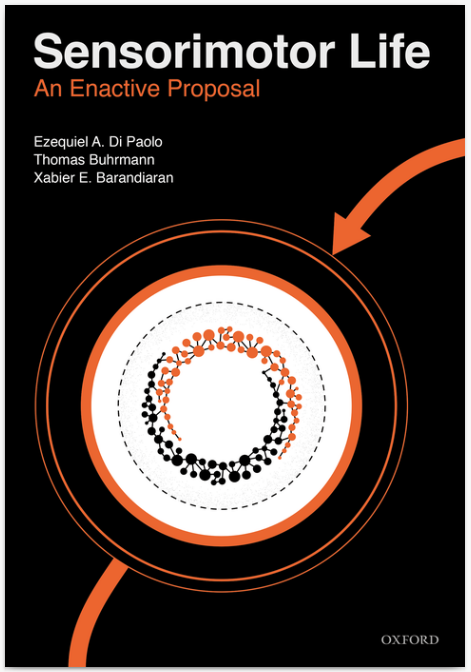
Chapters 5 and 6 of the book are based on my PhD thesis and I am proud to see it published within the more ellaborate framework of this book.
From the official summary of the book: «Sensorimotor Life draws on current theoretical developments in the enactive approach to life and mind. It examines and expands the premises of the sciences of the human mind, while developing an alternative picture closer to people’s daily experiences. Enactive ideas are applied and extended, providing a theoretically rich, naturalistic account of meaning and agency. The book includes a dynamical systems description of different types of sensorimotor regularities or sensorimotor contingencies; a dynamical interpretation of Piaget’s theory of equilibration to ground the concept of sensorimotor mastery; and a theory of agency as organized networks of sensorimotor schemes, as well as its implications for embodied subjectivity.»
Hace a penas dos semanas que publicamos el libro colectivo (editado por Laura Roth, Antonio Calleja y Arnau Monterde) Ciudades Democráticas: La revuelta municipalista en el ciclo post-15M. Soy autor de uno de los capítulos titulado «Tecnopolítica, municipalismo y radicalización democrática» que recoge algunas de las ideas, prácticas, estrategias y desarrollos de dos años y medio de trabajo en el Ajuntament de Barcelona. Una perspectiva filosófico-política sobre la tecnología, la tecnocracia y la democracia en la era del capitalismo cognitivo y los comunes digitales.







 Xabier E. Barandiaran