Outonomy book is out!

I am very happy to announce the publication of Outonomy: Fleshing out the Concept of Autonomy Beyond the Individual, edited by Arantza Etxeberria and me. This book is the unified and integrated result of our the research project of the same title lead by myself and Leonardo Bich that finished over a year ago. The book gathers a rich, cross-disciplinary exploration of autonomy that moves beyond the classic, self-sufficient, abstract, rational and detached model of the individual we inherited from modernity. Instead, it develops the concept of outonomy to capture how autonomy is constituted through relations: with environments, other agents, technologies, institutions, and social-ecological systems.
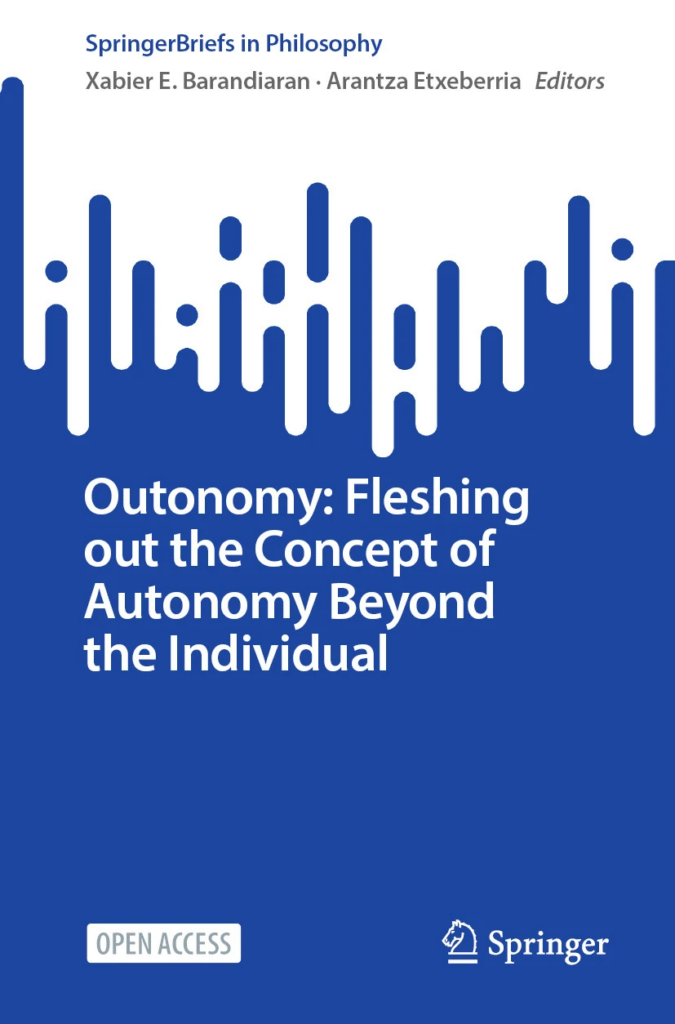
This image has an empty alt attribute; its file name is image-675x1024.png

Why “Outonomy”?

Autonomy has long been central to modern thought, ethics, and the life sciences. But many contemporary debates across philosophy of biology, cognitive science, medicine, technology studies, and political theory show that the boundaries and concerns of the individual more far beyond itself. The outonomy framework responds to this situation by offering a more interactional and environmentally situated account of self-governance and normativity.

In the opening chapter, Barandiaran and Etxeberria outline 4 key properties that help articulate this shift:

  • Interactivity
  • Collectivity
  • Extensionality
  • Environmentality

Along two fundamental dimensions:

  • Integration
  • Sustainability

Together, these ideas reframe autonomy as something that emerges across scales of interaction and dependence, rather than something sealed within an isolated individual.

A structured journey across life, mind, technology, and politics

The volume is organized into four parts that build a coherent arc while engaging multiple domains:

Part I: Theoretical Insights
Foundational chapters clarify the conceptual stakes of outonomy and rethink control and organization in biological systems.

Part II: The Fabric of Life
Chapters address environments and asymmetries, the origins of life, reproduction, and a compelling application to menstrual health.

Part III: The Psychic Self and Its Environment
Here the outonomy perspective extends into psychiatry, salutogenesis, and pain, emphasizing embodied and relational normativity.

Part IV: Technology, Ecology & Politics
These chapters explore technocomplexity, the limits of autonomy in social-ecological systems, subjects-in-common, and mindshaping in relation to adaptive preferences.

Co-authored chapters

I have co-edited the book, and co-authores three chapters:

  • Barandiaran, X. E., & Etxeberria, A. (2026). Outonomy, the Very Idea. In X. E. Barandiaran & A. Etxeberria (Eds.), Outonomy: Fleshing out the Concept of Autonomy Beyond the Individual (pp. 3–12). Springer Nature Switzerland. https://doi.org/10.1007/978-3-032-05501-9_1
    • Here we introduce the concept of Outonomy as an attempt to overcome some of the limitations of the concept of autonomy as inherited from modernity.
  • Cabello, V., Merlo, A., Mancilla, M., Siqueiros, J. M., & Barandiaran, X. E. (2026). Autonomy and Its Limits in Social-Ecological Systems. In X. E. Barandiaran & A. Etxeberria (Eds.), Outonomy: Fleshing out the Concept of Autonomy Beyond the Individual (pp. 121–130). Springer Nature Switzerland. https://doi.org/10.1007/978-3-032-05501-9_12
    • In this chapter, we approach the notion of autonomy at its largest planetary scale. Social-ecological systems are in need of a deep exercise of autonomy as self-limitation and care if we are to avoid the increasing destruction of living diversity and flourishing life on earth.
  • Calleja-López, A., Pérez-Verdugo, M., & Barandiaran, X. E. (2026). Autonomy and Technology: From Instrumentalism to Technocomplexity. In X. E. Barandiaran & A. Etxeberria (Eds.), Outonomy: Fleshing out the Concept of Autonomy Beyond the Individual (pp. 111–120). Springer Nature Switzerland. https://doi.org/10.1007/978-3-032-05501-9_11
    • This chapter captures the dialectical moments that tie autonomy and technology, from the naïve, yet widespread, instrumental use to the techno-complex participatory constitution of our extended life, passing through the persistent thread of an increasingly autonomous techno-economic system that subsumes and alienates human autonomy.

A collaborative research effort

The book emerges from sustained work within the Outonomy research network and related projects, with authors actively reviewing and strengthening each other’s contributions. It also benefits from external reviewers who helped refine the final manuscript.

Download and read the book or some of its chapters:
Outonomy: Fleshing out the Concept of Autonomy Beyond the Individual

Personal Autonomy and (Digital) Technology: An Enactive Sensorimotor Framework

I am glad to share this new publication in collaboration with Marta Pérez-Verdugo (first author and main contributor to this paper). This is my first (probably the first?) serious and deep philosophical application of sensorimotor life theories of cognition to digital, and more generally technological, environments. It also brings with it ethical and political implications in the way in which digital environments constraint technopolitical autonomy, and makes a notable contribution to the connection between autonomy in moral philosophy and autonomy in enactive theorizing (thanks to the great work made by Marta). The paper is also very programmatic and foundational, for it characterizes technology and technical behaviour in enactive terms and opens the way to further developments to come. Finally, the paper illuminates the way in which we get so often captured or steered by interface design in digital platforms and how to build autonomy-enhancing digital environments.

Pérez-Verdugo, M., & Barandiaran, X. E. (2023). Personal Autonomy and (Digital) Technology: An Enactive Sensorimotor Framework. Philosophy & Technology, 36(4), 84. https://doi.org/10.1007/s13347-023-00683-y.

ABSTRACT: Many digital technologies, designed and controlled by intensive data-driven corporate platforms, have become ubiquitous for many of our daily activities. This has raised political and ethical concerns over how they might be threatening our personal autonomy. However, not much philosophical attention has been paid to the specific role that their hyper-designed (sensorimotor) interfaces play in this regard. In this paper, we aim to offer a novel framework that can ground personal autonomy on sensorimotor interaction and, from there, directly address how technological design affects personal autonomy. To do this, we will draw from enactive sensorimotor approaches to cognition, focusing on the central notion of habits, understood as sensorimotor schemes that, in networked relations, give rise to sensorimotor agency. Starting from sensorimotor agency as a basis for more complex forms of personal autonomy, our approach gives us grounds to analyse our relationship with technology (in general) and to distinguish between autonomy-enhancing and autonomy-diminishing technologies. We argue that, by favouring/obstructing the enactment of certain (networks of) habits over others, technologies can directly act upon our personal autonomy, locally and globally. With this in mind, we then discuss how current digital technologies are often being designed to be autonomy-diminishing (as is the case of “dark patterns” in design), and sketch some ideas on how to build more autonomy-enhancing digital technologies.

Interaction Dynamics and Autonomy

maguilera_thesis-2I am glad to post that Miguel Aguilera presented his PhD thesis and is now officially a doctor in cognitive science by the University of Zaragoza. His thesis «Interaction Dynamics and Autonomy in Cognitive Systems» is a rare, challenging, broad, audacious and brilliant contribution to the study of autonomous systems. How does a «self» or an «autonomous system» emerge and constitute itself through interactions with the environment? It seems the answer is impossible to provide, you need to have a self, an identity, before it starts interacting with the environment, but, at the same time, some forms of sensorimotor or cognitive identity emerge and sustain themselves through interactions. You are an example yourself: your identity is the result of your actions, and your actions are caused by you. How could this be? Can we formalize and model this type of emergence of autonomous organizations through interactions? This is the fundamental question addressed by Dr. Aguilera. And the results are innovative, profound, operational and insightful. The core of the thesis is a robotic model capable to switch spontaneously between different behavioural preferences, and whose control architecture is itself a novel contribution to robotics: a kuramoto oscillatory network whose connections plastically change so as to keep macroscopic relationships homeostatic. The robot is a system that is capable to maintain its own behavioural organization while shifting preferences. Nothing is hard-coded, the controller is designed using a carefully scaffolded evolutionary optimization algorithm that gave rise to a complex dynamical system that shows macroscopic properties that emerge from distributed interactive processes at different timescales.

But this is not the major contribution of the thesis.
Seguir leyendo «Interaction Dynamics and Autonomy»

The multitudinous autonomous collective identity of the 15M

We just published a beautiful paper trying to understand the structure and dynamics of the 15M communication networks and they way in which they give rise to forms of collective identity.

Network analysis of the multitudinous collective identity of the 15M network (green)
Network analysis of the multitudinous collective identity of the 15M network (green) compared to traditional labour unions (in red). Click on the picture to enlarge.

Abstract: The emergence of network-movements since 2011 has opened the debate around the way in which social media and networked practices make possible innovative forms of collective identity. We briefly review the literature on social movements and «collective identity», and show the tension between different positions stressing either organization or culture, the personal or the collective, aggregative or networking logics. We argue that the 15M (indignados) network-movement in Spain demands conceptual and methodological innovations. Its rapid emergence, endurance, diversity, multifaceted development and adaptive capacity, posit numerous theoretical and methodological challenges. We show how the use of structural and dynamic analysis of interaction networks (in combination with qualitative data) is a valuable tool to track the shape and change of what we term the «systemic dimension» of collective identities in network-movements. In particular, we introduce a novel method for synchrony detection in Facebook activity to identify the distributed, yet integrated, coordinated activity behind collective identities. Applying this analytical strategy to the 15M movement, we show how it displays a specific form of systemic collective identity we call «multitudinous identity», characterized by social transversality and internal heterogeneity, as well as a transient and distributed leadership driven by action initiatives. Our approach attends to the role of distributed interaction and transient leadership at a mesoscale level of organizational dynamics, which may contribute to contemporary discussions of collective identity in network-movements.

  • Monterde, A., Calleja-López, A., Aguilera, M., Barandiaran, X. E., & Postill, J. (2015). Multitudinous identities: a qualitative and network analysis of the 15M collective identity. Information, Communication and Society, doi: 10.1080/1369118X.2015.1043315