I really do think with my pen, because my head often knows nothing about what my hand is writing WITTGENSTEIN
I’m excited to share a recent publication co-authored with Marta Pérez-Verdugo titled Generative Midtended Cognition and Artificial Intelligence: Thinging with Thinging Things. This paper represents an initial step in our broader exploration of how generative AI transforms human cognitive agency in ways that traditional frameworks of extended cognition fall short of capturing.
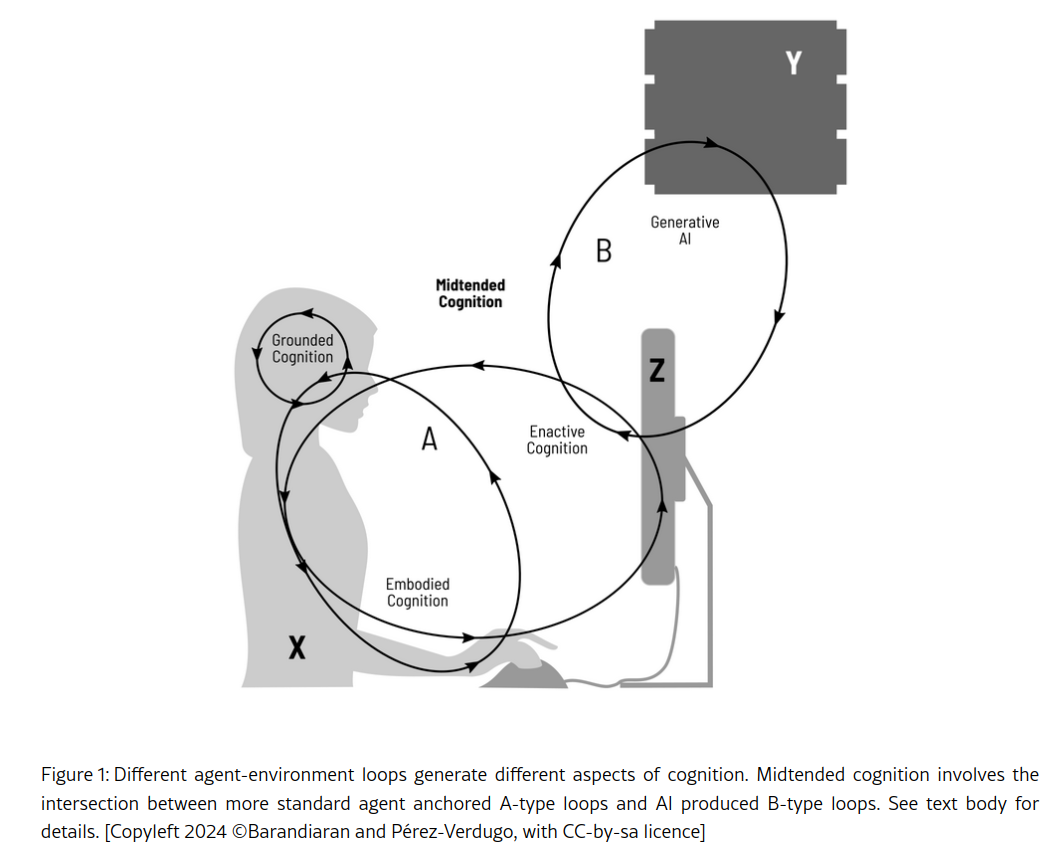
Did you ever experience the situation in which a human provided you with the word you were struggling to find out, accepted the suggestion, made it your own, and kept talking? Well, it happens that generative AI technologies are expanding this phenomenon to unprecedented levels. In this paper we start thinking about the consequences. To do so our work introduces the novel concept of «generative midtended cognition.» This term describes a hybrid cognitive process where generative AI becomes part of human creative agency, enabling interactions that sit between intention and extension: thus midtention. With AI’s ability to iteratively generate complex outputs, «midtended» cognition reflects the creative process where humans and AI co-generate a product, shaping the outcome together (see figure below). We explicitly define midtended cognition as follows:
Given a cognitive agent X, a generative system Y (artificial or otherwise) and cognitive product Z, midtension takes place when generative interventions produced by Y become constitutive of the intentional generation of Z by X, whereby X keeps some sense of agency or authorship over Z.
For those interested in cognitive science, philosophy of mind, or the implications of generative AI, this paper offers a theoretical basis to understand the cognitive depth of these human-AI interactions. Beyond classical extended, enactive and material cognition approaches, we suggest that generative AI initiates a form of cognition closer to social interactions than classical extended cognition approaches to technology. Yet, interacting with a generative AI is not itself a social interaction stricto sensu. It is something new. In order to get a better grasp on this novelty, we introduce and analyse two dimensions of “width” (sensitivity to context) and “depth” (granularity of interaction).
Given the unique generative power of these technologies and the hybrid forms of human-environment interactions they make possible, it’s essential to address both the promising potential and the ethical challenges they introduce. The paper explores multiple scenarios, from authenticity risks to the spectre of cognitive atrophy. But perhaps, it points out to a new concept we find particularly revealing and worth a follow-up paper to develop in depth: that of the economy of intention. We have previously analysed the concept of the economy of attention, an economic driver of contemporary social order and disorders. The phenomenon of Midtended Cognition might well move cognitive capitalism a step forward into a deeper commodification of the mind: not only the information that captures our attention, but the very intentional plans, creations, and projects we make «our own» might now be vulnerable to corporate injection.
ABSTRACT: This paper introduces the concept of “generative midtended cognition”, that explores the integration of generative AI technologies with human cognitive processes. The term «generative» reflects AI’s ability to iteratively produce structured outputs, while «midtended» captures the potential hybrid (human-AI) nature of the process. It stands between traditional conceptions of intended creation, understood as steered or directed from within, and extended processes that bring exo-biological processes into the creative process. We examine the working of current generative technologies (based on multimodal transformer architectures typical of large language models like ChatGPT), to explain how they can transform human cognitive agency beyond what the conceptual resources of standard theories of extended cognition can capture. We suggest that the type of cognitive activity typical of the coupling between a human and generative technologies is closer (but not equivalent) to social cognition than to classical extended cognitive paradigms. Yet, it deserves a specific treatment. We provide an explicit definition of generative midtended cognition in which we treat interventions by AI systems as constitutive of the agent’s intentional creative processes. Furthermore, we distinguish two dimensions of generative hybrid creativity: 1. Width: captures the sensitivity of the context of the generative process (from the single letter to the whole historical and surrounding data), 2. Depth: captures the granularity of iteration loops involved in the process. Generative midtended cognition stands in the middle depth between conversational forms of cognition in which complete utterances or creative units are exchanged, and micro-cognitive (e.g. neural) subpersonal processes. Finally, the paper discusses the potential risks and benefits of widespread generative AI adoption, including the challenges of authenticity, generative power asymmetry, and creative boost or atrophy.
I have been working with Lola Almendros for almost two years on this paper. It has taken looong to finish. But it is now available as a preprint. Here is a quote of one of the central ideas:
ChatGPT operates as a gigantic (…) library-that-talks, enabling a dialogical engagement with the vast corpus of human knowledge and cultural heritage it has ‘internalized’ (compressed on its transformer multidimensional spaces) and that it is capable of recruiting effectively in linguistic exchange. The machine’s interlocution, though devoid of personal intentionality, bears the trace of human experience as transposed into digitalized textuality. The purpose-structured and bounded automatic interlocution, however, can be experienced as a genuine dialogue by the human subject.
Generative technologies, and more specifically, Large Language Models (like ChatGPT, Gemini, Mixtral, Llama, or Claude) are rapidly expanding and populating our everyday toolbox and interaction space. If philosophy is understood as the practice of crafting (new) concepts to (better) organize our life… we have some job to do! Many conceptualize LLMs as mere “dumb statistical engines”, others as “sentient persons” … But what are they exactly? We know they are capable of surpassing existing intelligence benchmarks while, at the same time, failing to solve some kinds of simple puzzles.
Inspired on Simondon’s insights that part of our alienation regarding technology has to do with our lack of understanding of what technical object are and how they work, this paper deepens into the architecture, processing and systemic couplings under which LLMs (like ChatGPT) operate. We contrast this operational structure with those of living agents to conclude that LLMs fail to meet the requirements that characterized them. If not as agents, then… how to categorize LLMs? Here is one proposal:
[M]ore than a self-bootstrapped Artificial Intelligence, ChatGPT, as an interlocutor automaton, is a computational proxy of the human collective intelligence externalized into a digitalized written body. It is, in turn, shaped and taken care of by hundreds of human and non-human lives. […] This happens not just at a contextual level or as an operational environment, but at a constitutive level. No LLM is an island. And their performative power, and derived agentive capacities (if any), inherently rest on human and planetary scale life.
Moreover:
LLMs display capacities that effectively mobilize human intelligence as embodied in massive textuality, affectively mobilize human intelligence in conversation, and can activate forms of hybrid agency previously unavailable for human intelligence.
And yet, the scale of LLM operations is immense and beyond explainable human capacity to fully conceptualized. For example, GPT-3 was trained on 570 GB of text data, equivalent to around 2 million books, which would take a human over 500 years to read. Moreover, processing tasks performed by LLMs involve computational operations on a scale that would take a human expert millions of years to replicate if carried out step-by-step. We conclude:
By a digitality that deep, it is reasonable to hold that the boundary between invention and discovery, between artifact and nature, between engineering and science is somewhat blurred. We have built LLMs as much as we have discovered their emergent capabilities.
This paper is a preliminary (ontological) analysis of LLMs and transformer technologies and their coupling with human agency. Our goal is to address the deep technopolitical challenges and opportunities that this type of devices (and their social-ecological support networks) have opened.
ABSTRACT: This paper investigates the ontological characterization of Large Language Models (LLMs) like ChatGPT. Between inflationary and deflationary accounts, we pay special attention to their status as agents. This requires explaining in detail the architecture, processing, and training procedures that enable LLMs to display their capacities, and the extensions used to turn LLMs into agent-like systems. After a systematic analysis we conclude that a LLM fails to meet necessary and sufficient conditions for autonomous agency in the light of embodied theories of mind: the individuality condition (it is not the product of its own activity, it is not even directly affected by it), the normativity condition (it does not generate its own norms or goals), and, partially the interactional asymmetry condition (it is not the origin and sustained source of its interaction with the environment). If not agents, then … what are LLMs? We argue that ChatGPT should be characterized as an interlocutor or linguistic automaton, a library-that-talks, devoid of (autonomous) agency, but capable to engage performatively on non-purposeful yet purpose-structured and purpose-bounded tasks. When interacting with humans, a «ghostly» component of the human-machine interaction makes it possible to enact genuine conversational experiences with LLMs. Despite their lack of sensorimotor and biological embodiment, LLMs textual embodiment (the training corpus) and resource-hungry computational embodiment, significantly transform existing forms of human agency. Beyond assisted and extended agency, the LLM-human coupling can produce midtended forms of agency, closer to the production of intentional agency than to the extended instrumentality of any previous technologies.
I am pleased to share with you a recent publication co-authored with Alex Merlo. The paper is an important first step in Alex’s PhD thesis of exploring the politics of the earth system from the point of view of philosophy of science. The paper touches upon classical topics of autonomous and enactive approaches to life and mind, but at a scale that has rarely been the focus of our analysis: thermodynamics at the planetary scale. For those of you interested in climate change, thermodynamics and life, or, from a philosophy of science perspective, on «extremum principles» (maximum entropy, etc.), I think the paper has a lot to offer. It also has important political implications. We have been motivated to debunk fatalism, which is almost a kind of zeitgeist among many today. Reactionary postmodern authors like Nick Land, who rest the collective mind on the accelerator of turbocapitalism, are among our covert targets. But generally, the paper builds systematic arguments against all those approaches that leave human and biological agency at the corner of maximimization principles (with alleged thermodynamic foundations): «there is nothing we can do to stop our fate but to accelerate or decelerate the inevitable increase of entropy». It turns out, we argue, that what characterizes life on earth (that it, the only life we know) is its capacity to organize thermodynamic gradients to increase the diversity and frugality of life. It is time we also start to do so.
Merlo, A., & Barandiaran, X. E. (2024). Beyond fatalism: Gaia, entropy, and the autonomy of anthropogenic life on Earth. Ethics in Science and Environmental Politics, 24, 61–75. https://doi.org/10.3354/esep00213
ABSTRACT: The current disruption of ecosystems and climate systems can be likened to an increase in entropy within our planet. This concept is often linked to the second law of thermodynamics, which predicts a necessary rise in entropy resulting from all material and energy-related processes, including the intricate organisation of living systems. Consequently, discussions surrounding the ongoing crisis commonly carry an underlying sense of fatalism when referencing thermodynamic principles. In this study, we explore how the understanding of life has been harmonized with thermodynamics to show that entropy production is a consequence of heightened complexity in life rather than its breakdown. Furthermore, it is crucial to perform a thermodynamic analysis of the Earth system as a whole to dispel fatalistic assumptions. The extremum principles linked to thermodynamics do not foretell the precise evolution of complex organisations but rather set the thermodynamic boundaries associated with their development. Ultimately, treating the Earth system as an integrated autonomous entity in which life and human societies play pivotal roles is essential for charting a sustainable path forward for humanity. Understanding how to contribute to thermodynamic states that are more conducive to life, rather than hastening the journey towards disordered states, is paramount for human survival and well-being in the Anthropocene era.
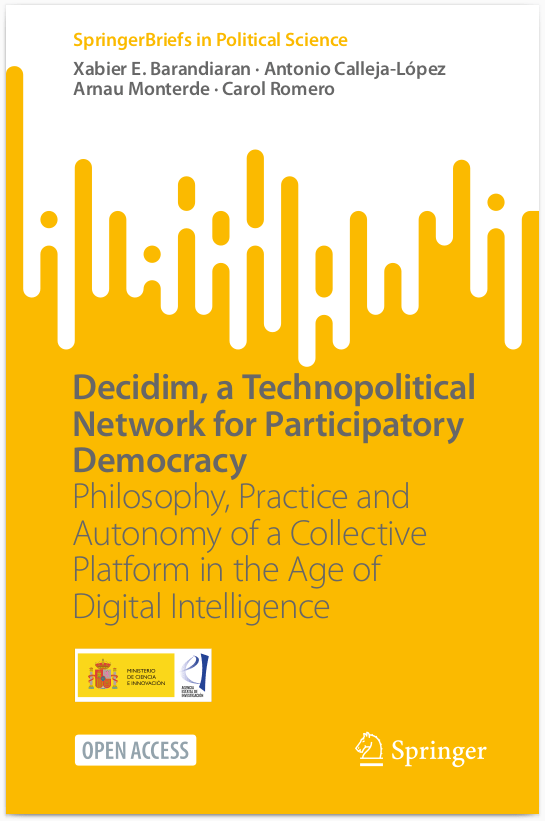
It has taken almost 6 years since we started writing what, at the time, we called Decidim’s White Paper. Some drafts of the early book have been circulating ever since, but we never completed the story. We were very busy doing Decidim. Years past, the project settled, and we took the time (thanks Antonio for offering us the great opportunity to push the book forward in Arantzazu!) to finally write it.
The table of contents of the book makes for a good summary:
Decidim: A Brief Overview
Here we summarize the nature of the project, its current impact, its history and why the project was born in the context of cognitive capitalism and the decline of neoliberal «democracies» on the one hand, and the dawn of digital commons and radical democracy on the other.
The Political Plane: Decidim and the Vision of a Radically Democratic Society
This part is the most theoretical, we review contemporary social and democratic theory to explain the type of democratic vision that Decidim is aimed to achieve.
The Technopolitical Plane: Decidim as a Democratic Software Paradigm
This chapter covers perhaps the most original aspect of the project, its careful technopolitical crafting, the way in which technical details are assembled to produce specific types of political effects and how the community embodies recursively those technical and political mechanism on its own constitution.
The Technical Plane: The Fabric of an Infrastructure
As the title anticipates, this is the most technical description of how the software, the community, the legal framework and the
A Technopolitical Network for Participatory Democracy: The Future of a Collective Platform
This is perhaps the most philosophical and speculative of all chapters. Recapitulating the content of the entire book, we project past, present and future challenges and provide a reading of what Decidim is and could be.
As an academic publication the book own much to the work of IAS-Research Group, and its decades of study of the autonomy of the living, now transposed to the autonomy of sociotechnical hybrids like this project: the democratic autonomous assemblage of the organic and the inorganic. The project Outonomy partially financed the publication with Open Access CreativeCommons By-SA licence.
I leave you with two quotes of the conclusions (chapter 5):
At the beginning of this book, we made clear that a project like Decidim might be necessary, but is certainly not sufficient for advancing democracy. There is no future for Decidim or for democracy without a deep transformation of the material living conditions, the social (and global) inequalities and the myriad of oppressive structures that are reproduced every day. Decidim should leave no room for techno-solutionism (the idea that social or political problems have technological solutions). It should equally debunk techno-fatalism. It already has. Decidim is an example of how it is possible to create and deploy a large-scale, radically transformative software project out of the platform capitalist model. An important challenge to any radical democratization process (particularly when addressing struggles) is the problem of coordination of collective action. This is where Decidim should be ready to become a valuable infrastructure, which may then contribute to address the challenges of complexity and conflictuality of society. (p. 124-5)
As a coagulation of hundreds of Metadecidim debates, the movement recursivity includes this very text; and so recrafts thinking, action, and, crucially, the frequently forgotten (re)production. We began suggesting that this book aims to think through Decidim after we did take part in it. Actually, we were thinking through Decidim as we were doing it, and Decidim keeps making and thinking itself today. With this book we came to recapitulate and throw out several lines of flight that show how Decidim has aimed to retie technology, politics, economics, ecology and beyond, and that flight has the form of a living animal: it is the flight of a cyborg owl. The cyborg owl can be taken as an imaginary ode to our animal and our technical, increasingly post-natural and allegedly post-humanist condition. Yet this owl is not the symbol of a Hegelian self-reflective movement that satisfies itself in contemplation, but the owl that flies in the evening to bring, back to the nest, the provision to sustain a new day. It is reflective action and active reflection aimed at producing and reproducing flourishing forms of life. (p.130-1)
Human collective intelligence facing an AI mediated future. [Image generated with DALL-E 3]
My life has come close to AI in different moments. I wrote my first AI program in 1999 (in Prolog), my first neural network in 2001. But I have mostly remained as an AI sceptic, more devoted to explore how Artificial Life models can partially disclose some of the intricate mysteries of life (biological, psychological, and social) than to the possibility of computer programs achieving anything close to human-level linguistic competence. I started to feel that something was changing in AI research when DeepMind first claimed to have succeeded in playing Go and, more importantly, in playing different computer games, using human controls (e.g. first-person visuomotor feedback), and without knowing or encoding the game rules in advance (Schrittwieser et al. 2020).
Philosophy has spent the last couple of centuries announcing the death of God, it is now time to remember that AI is not alive.
I could smell something was about to change quickly. Other indicators were already clearly visible (big tech buying small AI firms, among others). So, when I read that a company called OpenAI was accepting requests to use their GPT3 API, I rapidly signed for early access. I got hands onto GPT the 26th February 2021. I spent almost three days in a row hooked to my computer. I couldn’t believe what I was experiencing. Despite the lack of fine-tuning, the numerous hallucinations, the confusing interface (I had to discover what “prompting” meant for myself), … the experience was absolutely overwhelming. On my understanding of what computer could do, they simply were not supposed to do that 🙂
AI-driven corporation are already the new Gods, showing themselves as living on the clouds, as omniscient, omnipotent, transcendent, mysteriously incomprehensible, and biased, like any other God before
Parallel to my research on philosophy of mind and cognitive science, I have been a tech activist for a couple of decades. I could feel that what I just witnessed, talking to a computer program that wasn’t playing the silly psychoanalytic trick, was about to “change everything”. Two years latter I am still not surprised, although I start to be tired, of hearing it. And they are good reasons for it.
AI is really a compressed form of digitized and automatized Collective Intelligence
It is still difficult to stop thinking on the philosophical, political and, at large, social consequences of the changes to come (none of which, by the way, should make us forget that caring for human lives, and for life on earth must, be the absolute priority for everyone, that there is no AI that is going to save us).
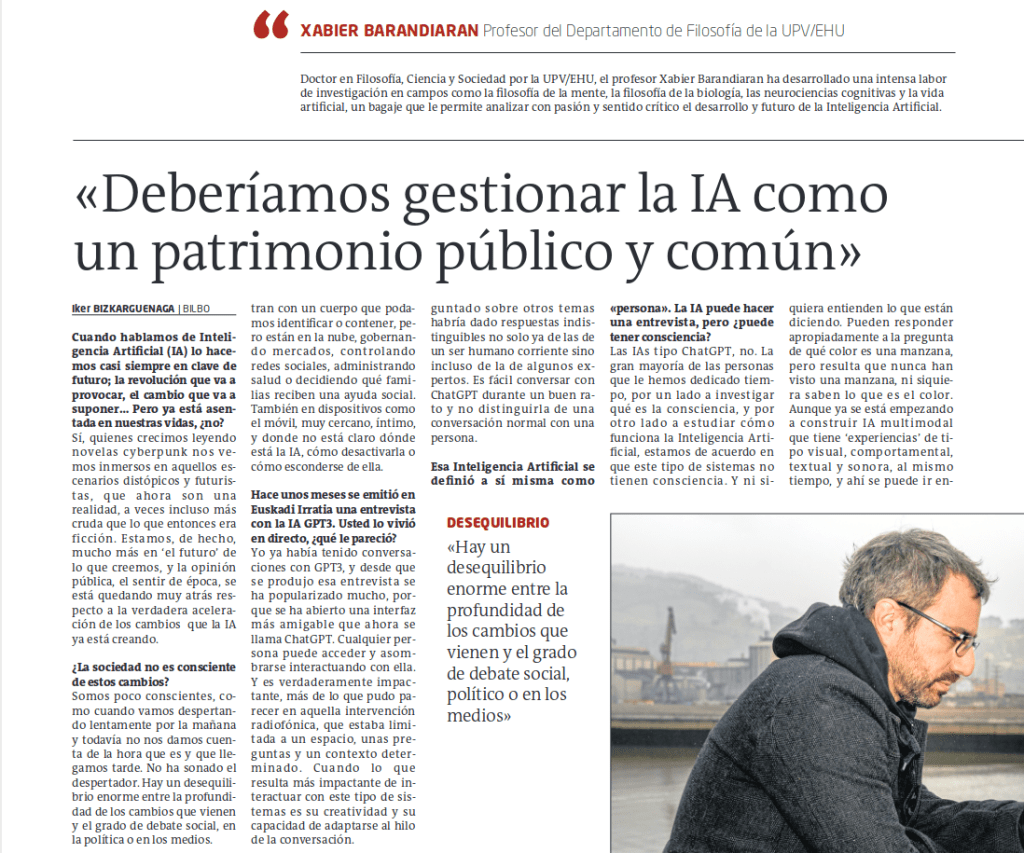
During these couple of years I have been asked to participate in different talks, interviews, round-panels, etc. And 2023 was particularly active. Collected here, you can find a number of media interventions in English, Spanish and Basque, where I elaborate on different aspects of the ongoing AI «revolution». In these interventions, I have aimed to explore the ethical, societal, and technological dimensions of AI, reaching out to diverse audiences. But they all touch upon 3 main ideas:
If not all, at least the most recently successful AI, is really a compressed form of digitized and automatized Collective Intelligence, that is the structured result of large scale human cognitive live sedimented in the huge mathematical apparatus sustaining AI, on the gigantic corpus of textual and visual data used during training and the huge amounts of cognitive and emotional labour put on reinforcement learning and curating the data.
The transformations to come are so deep that, in order to understand and cope with it, we might only rely on socio-cultural resources coming from religious studies and the transformations that the invention of writing brought to human life. AI-driven corporation are already the new Gods, showing themselves as living on the clouds, as omniscient, omnipotent, transcendent, mysteriously incomprehensible, and biased, like any other God before. Philosophy has spent the last couple of centuries announcing the death of God, it is now time to remember that AI is not alive. And yet, for years to come, we might not be able to live without AI. In a sense, they are the new undead Gods.
We are the life of AI, and the complexity and power of these new technologies cannot rest on the hands of private corporate industries. Democratizing AI is an urgent task. It already belongs to us, we need to reclaim it back. Beyond regulation, political action need to take innovative agency. It is not about acceleration or deceleration, it is about steering our futures.
1. Interventions in English
TALK: «Artificial Collective Intelligence and Democracy through Decidim» I was invited to deliver a talk on AI and Democracy at the #DecidimFest23 on a session entitled «Artificial Intelligence for Citizen Participation», on November 14, 2023, focusing on the application of AI in enhancing citizen participation. Watch on YouTube
RADIO INTERVIEW: Ética para la Inteligencia Artificial: From the “Leaders in Tech” series on EITB (October 28, 2023), this segment delves into the social and political aspects of AI development. It is a relative long interview for a public radio station (about 45 minutes) and I enjoyed the experience. I didn’t choose the title and I don’t like it, but I came given to me. Link
RADIO INTERVENTION: «GPT3 adimen artifiziala elkarrizketatu du ‘Faktoria’k«: An exploration of GPT-3’s capabilities on EITB’s «Faktoria» with Guridi, I., on November 4, 2022. In a previous interview, I convinced this radio program directors that they could interview an AI system. It took them almost a year to make this step, when they finally did (with the help of NLP experts from my university) I was invited to participate on the programme.
I am glad to share this new publication in collaboration with Marta Pérez-Verdugo (first author and main contributor to this paper). This is my first (probably the first?) serious and deep philosophical application of sensorimotor life theories of cognition to digital, and more generally technological, environments. It also brings with it ethical and political implications in the way in which digital environments constraint technopolitical autonomy, and makes a notable contribution to the connection between autonomy in moral philosophy and autonomy in enactive theorizing (thanks to the great work made by Marta). The paper is also very programmatic and foundational, for it characterizes technology and technical behaviour in enactive terms and opens the way to further developments to come. Finally, the paper illuminates the way in which we get so often captured or steered by interface design in digital platforms and how to build autonomy-enhancing digital environments.
ABSTRACT: Many digital technologies, designed and controlled by intensive data-driven corporate platforms, have become ubiquitous for many of our daily activities. This has raised political and ethical concerns over how they might be threatening our personal autonomy. However, not much philosophical attention has been paid to the specific role that their hyper-designed (sensorimotor) interfaces play in this regard. In this paper, we aim to offer a novel framework that can ground personal autonomy on sensorimotor interaction and, from there, directly address how technological design affects personal autonomy. To do this, we will draw from enactive sensorimotor approaches to cognition, focusing on the central notion of habits, understood as sensorimotor schemes that, in networked relations, give rise to sensorimotor agency. Starting from sensorimotor agency as a basis for more complex forms of personal autonomy, our approach gives us grounds to analyse our relationship with technology (in general) and to distinguish between autonomy-enhancing and autonomy-diminishing technologies. We argue that, by favouring/obstructing the enactment of certain (networks of) habits over others, technologies can directly act upon our personal autonomy, locally and globally. With this in mind, we then discuss how current digital technologies are often being designed to be autonomy-diminishing (as is the case of “dark patterns” in design), and sketch some ideas on how to build more autonomy-enhancing digital technologies.
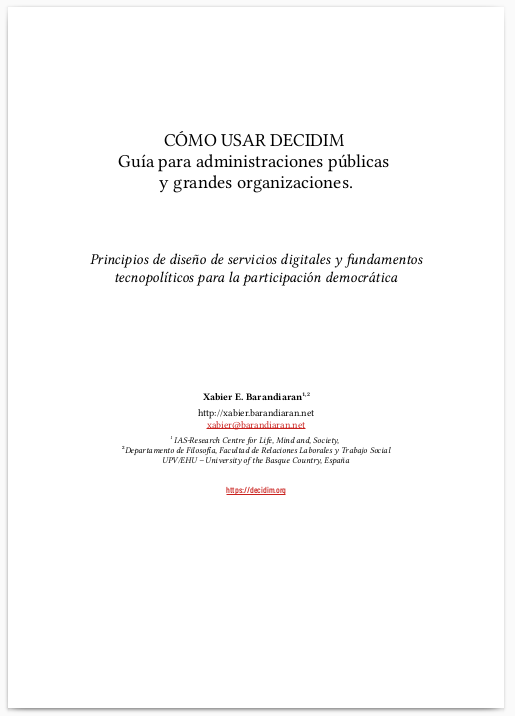
Son ya muchos los años que llevo implicado en el proyecto Decidim, con notables altibajos, desde su fundación y diseño original hasta mi más reciente incorporación en el nuevo comité de coordinación. Durante todos estos años me ha tocado aprender, asesorar, guiar y disfrutar de muchos usos de Decidim. En este documento sistematizo algunos de los aprendizajes más importantes realizados durante estos años.
RESUMEN: Este documento es un manual para aquellas organizaciones y administraciones públicas (ayuntamientos, gobiernos autonómicos y estatales, ministerios, etc.) que quieran ofrecer un servicio digital para la participación pública usando Decidim. La sociedad contemporánea está irreversiblemente atravesada por una red de servicios digitales o plataformas que reconfiguran el campo social. Las instituciones públicas y organizaciones sociales no son ajenas a este cambio pero generalmente no disponen de medios digitales propios. Existen, sin embargo, alternativas como Decidim que han permitido ya a más de 400 organizaciones en todo el mundo desplegar plataformas digitales capaces de articular la inteligencia colectiva de la ciudadanía en la producción de políticas públicas complejas. Decidim es toda una infraestructura digital libre, gratuita y abierta para la democracia participativa que permite desplegar una red social diseñada para desplegar procesos de participación, para estructurar y canalizar la actividad de diferentes órganos o asambleas, para realizar consultas, activar iniciativas ciudadanas o realizar grandes conferencias participativas. Este documento explica los elementos a tener en cuenta para contratar, configurar y poner en marcha un servicio digital para la democracia participativa a través de la plataforma Decidim. Explica su integración con otros servicios, así como recomendaciones de uso, despliegue y evaluación. Se detallan también una serie de principios tecnopolíticos que permiten diseñar mejor los procesos de participación, articular los órganos, y también hacer frente a los potenciales riesgos y explotar las oportunidades que ofrece Decidim dentro de las administraciones públicas.
Many people ask what is this project called «Decidim» to which I have devoted my last two year of work with complete dedication. I wanted to share a brief summary here. This text is the introduction of the Decidim’s White Paper (I am writing with Antonio Calleja and Arnau Monterde), to be published soon. I have systematized this text myself but it is really the product of a big group of people that have contributed to this project since its inception (Arnau Monerde, Andrés Lucena, Antonio Calleja, Carol Romero, Pablo Aragón and many others).
Decidim [http://decidim.org], from the Catalan «let’s decide» or “we decide”, is a digital infrastructure for participatory democracy, a digital platform, built entirely and collaboratively as free software. More specifically, Decidim is a web environment (a framework) produced in Ruby on Rails (a programming language) that allows anybody to create and configure a website platform to be used in the form of a political network for democratic participation. The platform allows any organization (local city council, association, university, NGO, neighbourhood or cooperative) to create mass processes for strategic planning, participatory budgeting, collaborative design for regulations, urban spaces and election processes. It also makes possible to connect traditional in-person democratic meetings (assemblies, council meetings, etc.) with the digital world: sending meeting invites, managing registrations, facilitating the publication of minutes, etc. In addition, Decidim enables the structuring of government bodies or assemblies (councils, boards, working groups), the convening of consultations, referendums or channelling citizen or member initiatives to trigger different decision making processes. Yet, the Decidim project is much more than that.
Definition
Decidim is a public-common’s, free and open, digital infrastructure for participatory democracy. It is convenient to explain the terms of this definition in inverse order.
By “participatory democracy” we mean that form of “government of the people and by the people” in which people take part as equals or peers (from latin pars, part, and capere, to take). By taking part we mean that people take the part of sovereignty of political life that belongs to them. And this should be an equal part for each, democracy is something that is done among peers.
The term “digital infrastructure” makes reference to a set of tools, resources, data-sets, documents, codes (legal, computer, etc.), interfaces and services that are digitalized or made accessible by digital means. This infrastructure is primarily a software platform for participatory democracy. Participants can create proposal, sign and support them, comment, receive notifications, attend public meetings or receive the minutes. Administrators can design participatory processes, define organs, configure types of initiatives or set up consultations. The infrastructure also includes documentation, design (icons, images, logos, etc.), legal documents, datasets or training resources, among others. All these, when organized as an infrastructure, make possible to deploy a participatory democratic system in any organization (be it a municipality, a cooperative, an association, a union or a community).
By “free and open” we mean that the project’s goods (the assets of the infrastructure) do no fall under the form of private property, that excludes others from access, usage, copy, modify and re-publish or reuse these resources but, instead, displays all the legal, technical and social means necessary to share them and open them to collaboration.
Finally, the term “public-common’s” indicates that the project is mostly financed and made possible by public institutions and is managed and designed by an open community constituted by public-servants, members of different associations, university researchers and students, activists and staff from foundations, workers from different companies or simply volunteers that commit to the principles of the project. For this infrastructure to be a common’s it is important that these partners organize democratically in relation to the project. In this sense Decidim is a reflexive infrastructure that uses the very infrastructure to democratize itself.
Platform features and functional architecture
Since the digital platform displays and embodies both the means of project organization and its democratic principles, it is important to explain how the platform works. Users of the platform (participants) interact through participatory mechanisms known as components within different participatory spaces that channel their democratic power to specific results. These are the frameworks that define how participation will be carried out, the channels or means through which citizens or members of an organization can process requests or coordinate proposals and make decisions. Initiatives, Processes, Assemblies and Consultations are all participatory spaces. Specific examples of each of these include: a citizen initiative for directly changing a regulation (Initiative); a general assembly or workers’ council (Assembly); a participatory budgeting, strategic planning, or electoral process (Processes); a referendum or call to vote “Yes” or “No” to change the name of an organization (Consultation). The more notable components that are combined into spaces to deliver participatory mechanisms include in-person meetings, proposals, blogs, debates, static information pages, surveys, votes, results and comments. So, for example, the various phases of a participatory budgeting process (where members of an organization are called to decide how to spend a budget) can combine components in the following way: at an early phase public meetings can be opened for citizens to analyze different needs classified by districts. In turn these meetings can lead to the design of a survey. The survey results can next be used to define a set of categories for projects to be proposed. The proposal component might then be activated for participants to create and publish their projects as solutions to the identified needs. These proposals can be commented and after two weeks of deliberation the voting component can be activated to select among the projects with a budget-expenditure system. Participants can then be called to a public meeting to evaluate the results and an assessment survey can then be launched for those who could not attend the meeting. Finally, the accountability component can be activated to monitor the degree of execution of the selected projects and people can comment on it. This is but one example of how components are combined in a space, but there are many other combinatorial possibilities. What makes Decidim particularly powerful is this combination of components within spaces, which provides an organization with a complete toolkit to easily design and deploy a democratic system adapted to its needs.
The social contract
All members and partners of the Decidim project must endorse and follow a “social contract” (https://decidim.org/contract) that defines a set of guiding principles. The social contract can be summarized as follows: 1. Free software and open content: Decidim will always remain free and open to collaboration, without legal or technical obstacles for the use, copy and modification. To ensure this we use a set of licenses: Affero GPLv3 for the code, CreativeCommons By-SA for the content (text, images, design, etc.) and Open Access Database License for data. This means that Decidim will always remain auditable, collaborable, transparent, appropriable and trustworthy, all of which is fundamental for a democratic infrastructure. 2. Transparency, traceability and integrity: the content of participation will always remain transparent, traceable and integral. This means that all the content must be accessible and downloadable, it should always be known what happens with each proposal, its origin, in which result or decision is was incorporated or why it was rejected or left behind, and the content needs to be displayed without been manipulated, any modification (if required) must be registered and be accessible and auditable. 3. Equal opportunities: “The platform will offer equal starting opportunities to all participatory objects (proposals, debates, etc.) for them to be viewed, discussed, commented, evaluated or treated without discrimination of any kind” (direct quote from the contract). 4. Privacy with verification: participants must retain privacy of their personal data combined with verification. Personal data should never be displayed, nor sold or transferred to third parties while, at the same time, the unicity and democratic rights of participants must be preserved (meaning there cannot be two verified users corresponding to the same individual with democratic rights and all participants with such rights must be verifiable). 5. Democratic quality and guarantees: the platform must guarantee the democratic quality, the non-discrimination and equal opportunities for each participant and proposal. 6. Inclusiveness and multilayerness: the platform must comply with accessibility standards, its use must favour the integration of online and offline participation and organizations must deploy the means for mediation and training of participants.
Instances
The best known and intensively used instance of Decidim, as a digital platform for participatory democracy, is www.decidim.barcelona, with (as of March the 1st) more than 28,000 registered participants, 1,288,999 page views, 290,520 visitors, 19 participatory processes, 821 public meetings channeled through the platform and 12,173 proposals, out of which over 8,923 have already become public policies grouped into 5,339 results whose execution level can be monitored by citizens. The instance that actively explores more functionalities is meta.decidim.org, the community portal that designs and supports the project. There is also a demo site with the latest version available for exploration and a training instance open to anybody to learn how to configure, administrate and use the platform. There are currently more than 20 instances of Decidim for organizations of different sorts ranging from municipalities such as Helsinki or Pamplona, to regional governments like the Junta de Castilla la Mancha or the Generalitat de Catalunya, NGO networks such as Fundaction or QuorumGlobal, cooperatives like Somenergia, or the National Commission for Public Debate (Commission Nationale du Débat Public) in France.
A sustainable ecosystem
Developed at Barcelona’s Laboratory for Democratic Innovation, Decidim is the result of the joint effort of a network of collaborating entities and multiple participants leaded by Barcelona’s City Council. Appart from the organizations that use the platform and whose participants and administrators report bugs and suggest improvements, there is a network of 17 different collaborating entities, from software companies to institutional consortia, from research institutions to civil associations. The meta.decidim community uses an instance of the Decidim platform to organize the different dimensions of the project. As of April the 21st it has over 300 registered users, it hosts minutes of over 112 public meetings, details of 8 assemblies or working groups, 4 participatory processes (welcome process, bug reporting, feature proposals, and training workshop process) together with various initiatives and a consultations aimed at defining the roadmap and software design of the platform, bug reporting, community and project governance, research and development. Official documentation and code are developed on Github (https://github.com/decidim) where the project hosts 21 repositories with over 41 developers’ contributions. They all together generate a sustainable ecosystem that governs, produces and provides services over the platform (deployment, adaptation, configuration, training, consultancy, administration, etc.).
Democracy and social empowerment
Decidim was born in an institutional environment (that of Barcelona City Council), directly aiming at improving and enhancing the political and administrative impact of participatory democracy in the state (municipalities, local governments, etc.). But it also aims at empowering social processes as a platform for massive social coordination for collective action independently of public administrations. Anybody can copy, modify and install Decidim for its own needs, so Decidim is by no means reduced to public institutions. There are different ways in which participatory democracy infrastructures can boost social, economic and political self-organization. Decidim is starting to be used for these purposes: for the internal organization of consumer and producer cooperatives for example, it is also helping youth movements organize and design strategic planning, and it might soon be used to coordinate massive strikes or other forms of social action. The modular nature of the software architecture is also making possible for these organization to develop their own components and improvements (such as crowdfunding, membership management, etc.) and to plug them into Decidim, expanding its potential. Corporate digital platforms (Amazon, AirBnB, etc.) are disrupting private services and markets. Decidim comes to fill the gap of public and common’s platforms, providing an alternative to the way in which private platforms coordinate social action (mostly with profit-driven, data extraction and market oriented goals).
The political, the technical and the technopolitical
As we have repeatedly stressed, Decidim is more than a technological platform. It has required to assemble a variety of codes, realities and dimensions that go beyond programming code. We define it as a “technopolitical project” where legal, political, institutional, practical, social, educational, communicative, economic and epistemic codes merge together. Ultimately, Decidim is in itself a sort of crossroad of the various dimensions of networked democracy and society, a detailed practical map of their complexities and conflicts. We distinguish three general planes or dimensions of the project: the political (focused on the democratic model that Decidim promotes and its impact on public policies and organizations), the technopolitical (focused on how the platform is designed, the mechanisms it embodies, and the way in which it is itself democratically designed), and the technical (focused on the conditions of production, operation and success of the project: the factory, collaborative mechanisms, licenses, etc.). The political plane is best illustrated by the use of Decidim in a city or organization, the type of democratic processes and decisions that are made through it. In other words, it covers what kind of politics can be done using Decidim: what kind of governance, conflict and power relationships can be channeled through it: the kind of democracy it is capable to produce. Its model instance is decidim.barcelona, what happens within, how it alters the political space of the city. The second plane, the technopolitical, includes matters concerning the digital architectural design of Decidim: its interfaces, features, design principles, data policies, user experience, etc. It is a primarily a reflexive space of how technologies structure political processes. It is embodied in the meta.decidim platform and the community that surrounds it. Finally, the technical plane encompasses issues concerning primarily the programming and legal codes (information and legal infrastructures), but is also includes issues of education and knowledge (epistemic infrastructures). All three dimensions are part of the project.
Plane
Relation
Platform
Mode
Scale
Political
Superstructure
decidim.barcelona
Co-decision
City
Technopolitical
Structure
meta.decidim
Co-design
Community
Technical
Infrastructure
github.com/decidim
Co-production
Laboratory
Table 1: Systematization of various aspects of the Decidim project in the political, technopolitical and technical planes with the city of Barcelona as a reference.
I am glad to post that Miguel Aguilera presented his PhD thesis and is now officially a doctor in cognitive science by the University of Zaragoza. His thesis «Interaction Dynamics and Autonomy in Cognitive Systems» is a rare, challenging, broad, audacious and brilliant contribution to the study of autonomous systems. How does a «self» or an «autonomous system» emerge and constitute itself through interactions with the environment? It seems the answer is impossible to provide, you need to have a self, an identity, before it starts interacting with the environment, but, at the same time, some forms of sensorimotor or cognitive identity emerge and sustain themselves through interactions. You are an example yourself: your identity is the result of your actions, and your actions are caused by you. How could this be? Can we formalize and model this type of emergence of autonomous organizations through interactions? This is the fundamental question addressed by Dr. Aguilera. And the results are innovative, profound, operational and insightful. The core of the thesis is a robotic model capable to switch spontaneously between different behavioural preferences, and whose control architecture is itself a novel contribution to robotics: a kuramoto oscillatory network whose connections plastically change so as to keep macroscopic relationships homeostatic. The robot is a system that is capable to maintain its own behavioural organization while shifting preferences. Nothing is hard-coded, the controller is designed using a carefully scaffolded evolutionary optimization algorithm that gave rise to a complex dynamical system that shows macroscopic properties that emerge from distributed interactive processes at different timescales.
We just published a beautiful paper trying to understand the structure and dynamics of the 15M communication networks and they way in which they give rise to forms of collective identity.
Network analysis of the multitudinous collective identity of the 15M network (green) compared to traditional labour unions (in red). Click on the picture to enlarge.
Abstract: The emergence of network-movements since 2011 has opened the debate around the way in which social media and networked practices make possible innovative forms of collective identity. We briefly review the literature on social movements and «collective identity», and show the tension between different positions stressing either organization or culture, the personal or the collective, aggregative or networking logics. We argue that the 15M (indignados) network-movement in Spain demands conceptual and methodological innovations. Its rapid emergence, endurance, diversity, multifaceted development and adaptive capacity, posit numerous theoretical and methodological challenges. We show how the use of structural and dynamic analysis of interaction networks (in combination with qualitative data) is a valuable tool to track the shape and change of what we term the «systemic dimension» of collective identities in network-movements. In particular, we introduce a novel method for synchrony detection in Facebook activity to identify the distributed, yet integrated, coordinated activity behind collective identities. Applying this analytical strategy to the 15M movement, we show how it displays a specific form of systemic collective identity we call «multitudinous identity», characterized by social transversality and internal heterogeneity, as well as a transient and distributed leadership driven by action initiatives. Our approach attends to the role of distributed interaction and transient leadership at a mesoscale level of organizational dynamics, which may contribute to contemporary discussions of collective identity in network-movements.











 Xabier E. Barandiaran